Project 333 – Packing

2 Comments

For those of you who may be new to reading this blog, it is probably timely to explain about Project 333.  It is a concept developed by Courtney Carver in which you commit to wearing a maximum of 33 items for 3 months.  You can read all about it at her blog, Be More With Less.

I first discovered Project 333 in April 2012 and followed the guidelines carefully for the next 3 months.  Since then, I have continued to streamline the contents of my wardrobe.  I am constantly striving to create a small but effective selection of pieces which work for me.  For ease of searching, I have used “Project 333” in the title of all of my clothes-related posts.  If you have not read them all you can search all posts under this topic to gain a broad understanding of what I am doing.

I have been in Sydney for the past 2 days for work.  I needed to be appropriately dressed on Tuesday when I arrived as well as yesterday and today.  I was meeting friends for dinner on Tuesday evening and attending a work-related dinner last night.  The constraints were that I planned to only take carry-on luggage as well as staying in a hotel and no opportunity to wash clothes.

Here is what I packed.

Trousers
Green jeans, denim jeans and white 3/4 trousers.

Tops
Floral cardigan, teal top, red/white striped tee and black pullover.  These all have 3/4 sleeves.  I find these very practical for a range of weather and they can be worn in a variety of ways.

Extras
I also packed a black camisole, black/white checked short sleeved shirt and leopard print scarf.

Shoes
2 pairs of flat shoes completed the selection.  I try not to wear the same shoes every day.

I chose the items with a specific plan in mind but sufficient versatility to change the choices if my mood or the weather dictated it.  The plan (which I adhered to) was:

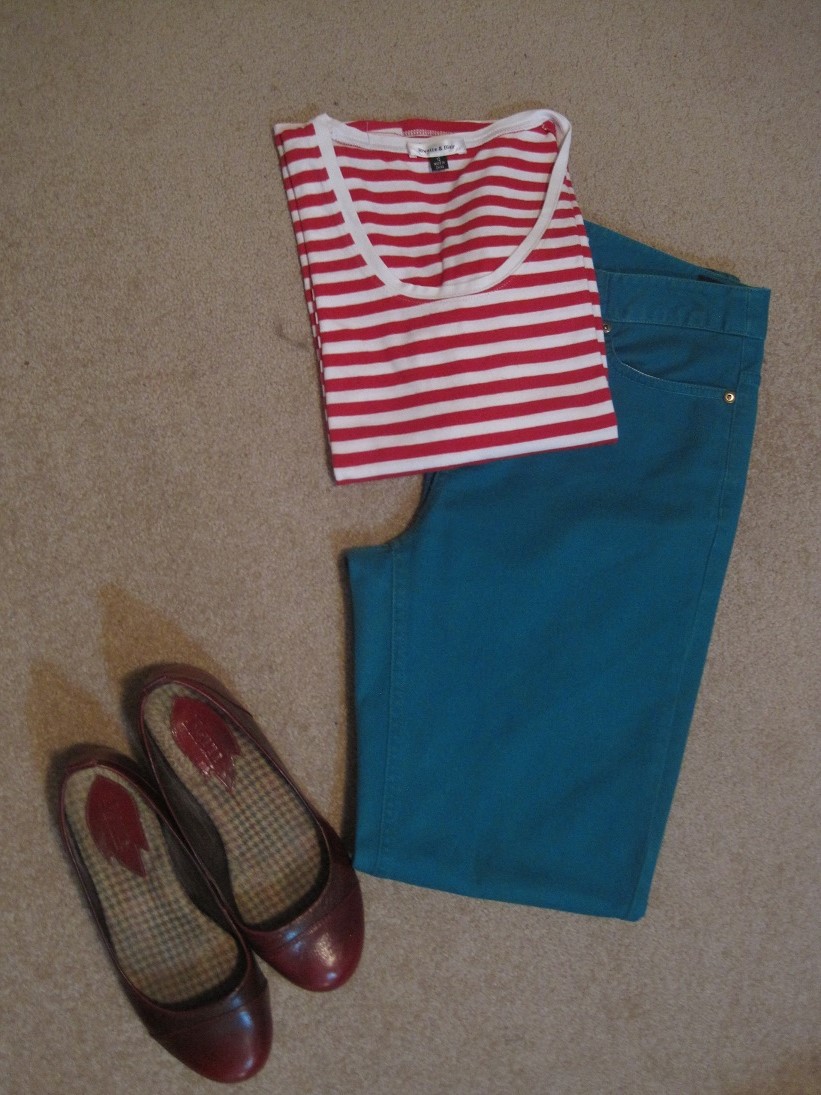
Denim jeans, red/white tee and red flats on Tuesday flight.
Green jeans, black pullover and scarf with pewter flats for dinner on Tuesday.
Green jeans, black camisole, floral cardigan and red flats – work on Wednesday
Denim jeans, black camisole, teal top and pewter flats – dinner on Wednesday.
White trousers, checked shirt with black pullover (if needed) and flats – work on Thursday and flight home.

I really only wore each item once , however, the combinations are almost endless.  The only ‘no go zones’ as far as I can see were the green jeans with the teal top, the red flats with the teal top or the the striped top and floral cardigan together!  My maths is not good enough to be able to calculate all of the possible permutations but I know there were plenty of choices.  All of this confirms what I have often said, “You need almost as many clothes for a couple of days as for a few weeks”.

How do you decide what to pack? Have you ever travelled for an extended period of time with only one bag?
Organised Kids

2 Comments

On Friday afternoon The Duke and I picked up Miss O as she was coming to stay for the night and most of Saturday before meeting up with her Mum at a family BBQ late on Saturday afternoon.

Whenever either of the grandchildren come to stay something invariably gets forgotten and it is often a toothbrush so we reminded Miss O when we arrived.  This time it was spare underwear that was left behind and then when it was bedtime she announced, “Mum forgot to pack any toys”.  I pointed out to her that it was not actually her mother’s responsibility to pack toys – after all Miss O is nearly 6.

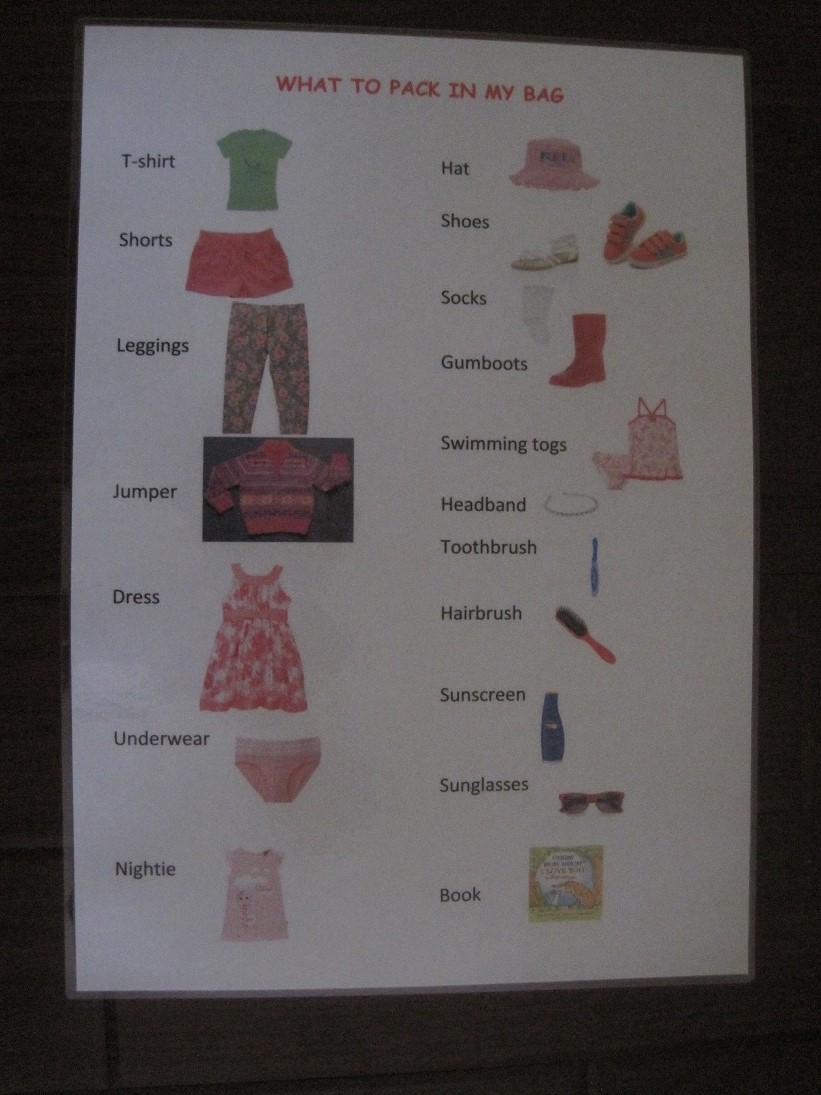
I decided to help Miss O to try to overcome things being forgotten so we made a packing list.

Packing list
This is what we created.  Miss O decided what needed to be on the list and with the aid of Google we found images to go with each item.  Naturally, there will be seasonal variations and not everything will be required each time she packs to go somewhere but I am hoping it will be a useful prompt.

We did not get it quite finished on Saturday but it is all done now, laminated and posted to Miss O as promised.

The picture prompts will also encourage her reading skills.

Project 333 – Making it Work 3

2 Comments

As promised, here are the next 3 outfits based on the black camisole.  This is the one from yesterday where I teamed the camisole with an overshirt and white 3/4 trousers.

Striped shirt 3
Outfit 2 – a completely different look by teaming the black camisole with a black/white check skirt, lacy gold bolero and metallic sandals.

Black camisole 2

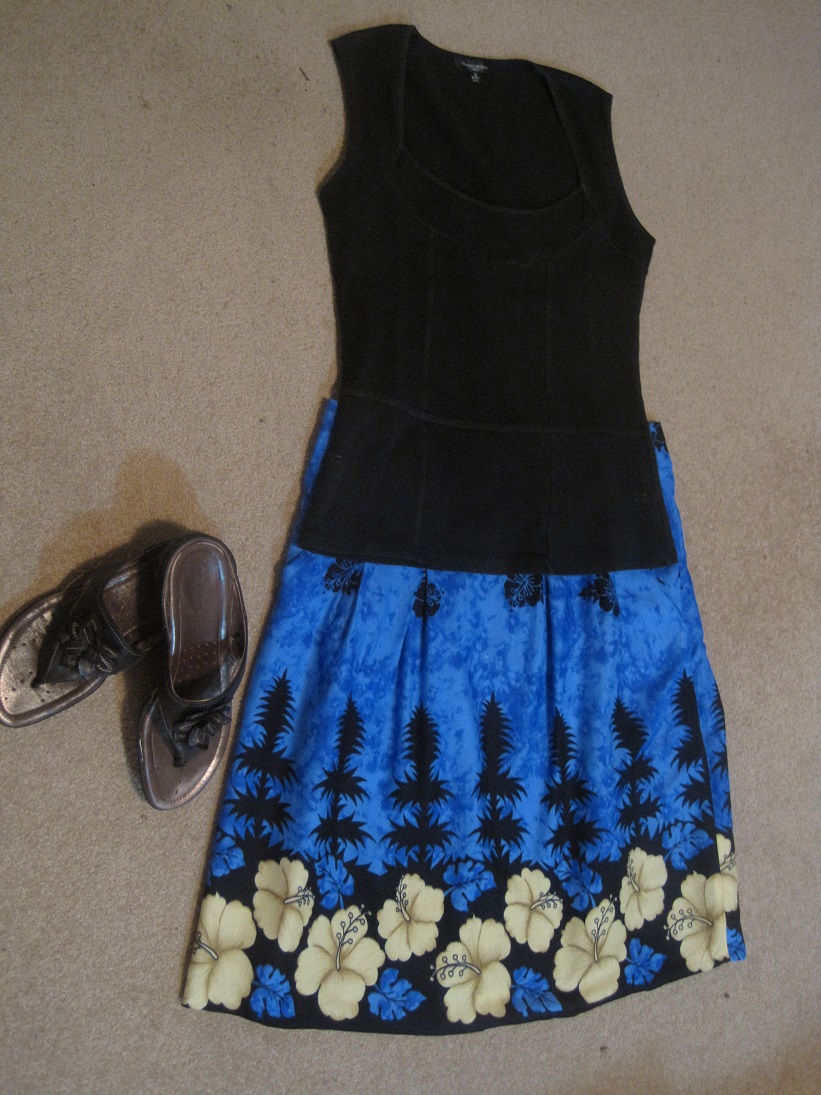
Outfit 3 – a simple, summery combination with the addition of a lightweight Hawaiin-print skirt and black slides.

Black camisole 3
I made the Hawaiin-print skirt from fabric that was given to me.  I love the skirt but it is very different to most items in my wardrobe so I have really set myself up for a challenge by choosing it as my base item for tomorrow.

Will I meet my goal of 3 different ways to wear it?

Project 333 – Making it Work 2

6 Comments

Now for the next instalment, using the striped shirt as the base for 3 outfits.

Here is the one from yesterday which I will call Outfit 1.

Green jeans2
Outfit 2 – black trousers, teal/black/white striped collared shirt with 3/4 sleeve and zip front, turquoise cardigan and black mary janes.

Striped shirt 2
Outfit 3 – white 3/4 pants, black camisole, teal/black/white striped collared shirt with 3/4 sleeve and black leather slides.

Striped shirt 3

Because we live in a temperate climate I have the luxury of being able to wear some of the more versatile items in all seasons.  This shirt is a perfect example.

Tomorrow I will show you 2 more ways I wear the black camisole.  There are many options for this piece but I will use the opportunity to introduce a couple of the more challenging items.

Project 333 – Making it Work

Leave a comment

As promised the other day, here is the first of a series about my small selection of clothes and how I make them work.

I read recently that someone expected that every item of clothing needed to be able to be incorporated into 3 different outfits to justify having the item in her cupboard.  I decided to test this theory and here are some of the results.

The first item I chose was my green jeans.

Green jeans1
Outfit 1 – green jeans, red/white striped 3/4 sleeve tee and red flats.

Green jeans2
Outfit 2 – green jeans, teal/black/white striped collared shirt with 3/4 sleeve and zip front plus pewter flats.

Green jeans3
Outfit 3 – green jeans, white camisole, charcoal denim jacket and black mary janes.

The great thing about this exercise is that it actually makes you think outside the box.  I have actually worn outfits 1 and 2 but outfit 3 was created purely as a result of this exercise.  I like the look of it and will definitely try it out.

Some items will easily give you 3 or more options while others will be a bit more of a challenge.  I am not just going to showcase the easy choices.  Each day I will select one of the pieces I used as my next base.  Tomorrow will be 2 more ways of wearing the striped shirt which you saw in Outfit 2 today.

I look forward to hearing your comments on my choices and if you have any strategies for making sure that your wardrobe items earn their keep.

Finally, I want to thank you all for your thoughts and prayers for my sister-in-law.  Her condition remains very serious and we continue to pray for her.

STREAMLINE – Everyday Maintenance

3 Comments

After you have worked through all of the other steps in the ‘STREAMLINE’ process, it is important not to lapse back into old ways.  Just like changing eating (or any other) habits, if your version of minimalism is to be successful it needs to be an ongoing process.  You will have to work at it constantly and be vigilant at every turn.  Clutter in all its forms is insidious and will soon overwhelm you if you do not have strategies in place to stop it at the door, the mailbox and even your email inbox.

Well-meaning friends and relatives may feel sorry for you when they see your empty spaces and want to give you stuff to fill the gaps.

You did not set out to create a cluttered, over-burdened life – it just happened.  So, it could easily happen again.

“No, thank you” is one of the most powerful things you can say in your quest to keep your stuff at the level which suits you best.  Whether it is a freebie bag at a conference, a loyalty card from a store, a copy of recipe or your great aunt’s tea-set – if it does not fit your goals you can politely refuse the offer.

Dining table

I have refused, decluttered and minimised for several years and still know that there is more to go.  I keep a bag/box in the spare room and as I find things to go they are moved to the box which then goes to the op shop when it is full.  Sometimes it takes ages to gather enough to send off and other times there is a flurry of activity and I take several bags in one weekend.  Having a dedicated receptacle for things that are to be re-homed helps me to keep focused.

I hope you have enjoyed this series and would strongly recommend reading “The Joy of Less” by Francine Jay for more inspiration.  Please share your thoughts on decluttering and minimalism in general and as well as your personal achievements.

STREAMLINE – Narrow it Down

Leave a comment

This is where it starts to get really challenging.  Now we need to ask ourselves the question, “What is the minimum that I need to live?”  Francine notes that you do not need to worry that you will be expected to sleep on the floor or live in a tent but you do need to challenge yourself.  It is not enough to wave your magic wand and say that you need everything that you have.

There is no magic number of items or even a formula that you can apply.  Everyone’s ‘enough’ is different.  It can depend on your location, family, children, hobbies, upbringing and experiences.

Embracing minimalism is a personal choice.  It is not about depriving yourself but giving yourself the freedom to live and enjoy the moment.  There is a liberating lightness which comes from letting go of possessions so take the time to look around you and decide what you can live without.

Contents of cupboard

Some of things you could consider when attempting to narrow down your possessions:

  • Duplicates – these are easy – you don’t really need 2 (or more) do you?
  • Sentimental stuff – Francine suggests ‘minituarising’ as a way of dealing with these – an example could be a place card, photo, swatch of dress fabric and a dried flower from the bouquet all in a simple frame as a wedding memento rather than keeping a wedding dress and all the trimmings.
  • Digitising – scanned photos in files on the computer rather than shelves full of albums that gather dust.  If the digitised files are well catalogued they are actually more accessible than hard copies.  You can also keep back-ups in different locations in case of disaster.

I do not purport to be perfect in any of these ways but am certainly working on it.  What about you?

STREAMLINE – Limits

5 Comments

In years gone by our stuff was limited to a large degree by the availability and cost of most items.  Goods were generally produced locally and in a relatively labour-intensive manner.  Disposable incomes were less and stuff cost more when compared to incomes.  Global manufacturing and transport, cheap labour and distribution have meant that there is a seemingly endless supply of stuff for you to purchase at your local shopping mall.

Since the natural limits of accessibility and affordability have been removed, it is up to us to take control or we will end up drowning in our stuff.  The ultimate limit is the size of your home; you can fit a lot more in a 2 storey, 4 bedroom family home than a studio apartment.  However, even this does not deter some people as evidenced by the burgeoning industry of off-site storage facilities.

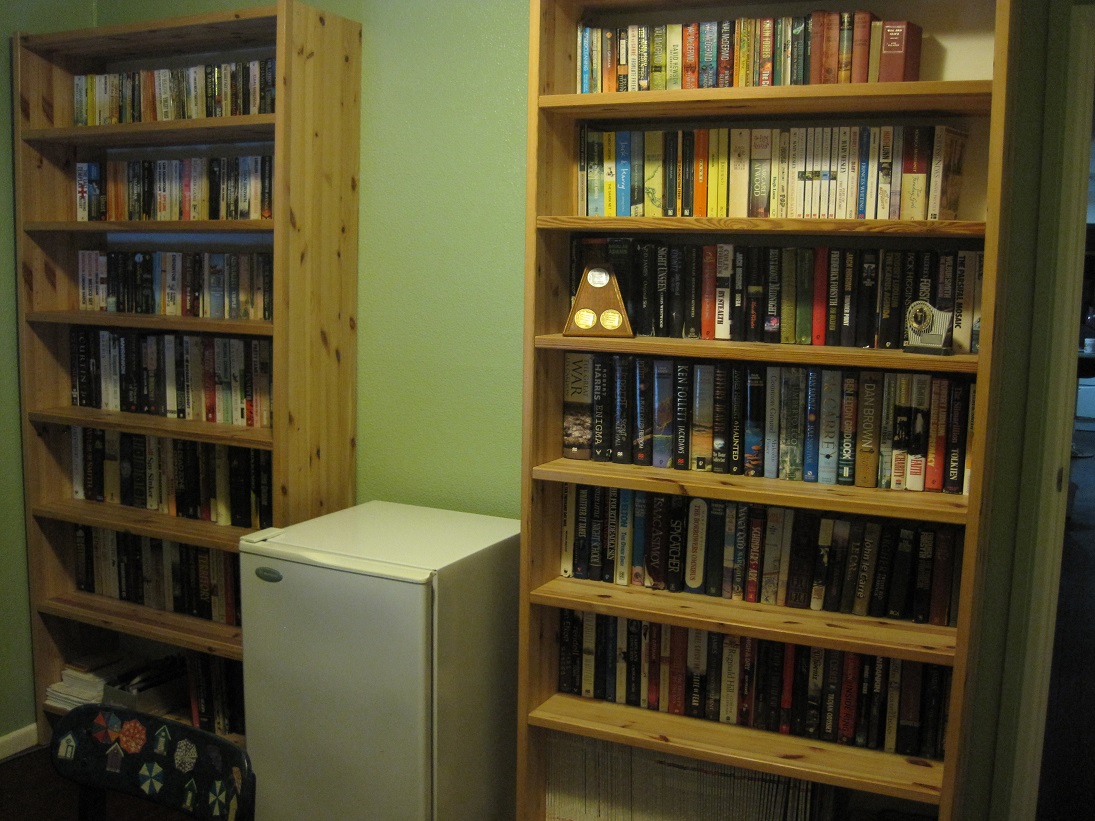
You can easily apply limits to things like your books by simply choosing not to have the shelves overflowing.  As you buy or acquire new books, make space for them by moving others along.  We all have books that we are not sure why we are keeping them.  Will you read them again?  No?  Time to go.  This way you will eventually end up with a selection of books that you really love and are proud to have on your shelves.

Bookshelves
Perhaps you can choose an arbitrary number such as 20 DVDs, 10 t-shirts or 6 champagne flutes.  Make sure that you don’t simply choose a number that allows you to maintain the status quo.  It needs to be challenging yet achievable as well as pertinent to your unique situation.

No matter what the item, you need to ask yourself the question, “Do I really need x of this item?”  Nothing needs to be immune from this process – lipsticks, plates, socks, CDs, towels, candles and cookbooks are all fair game.

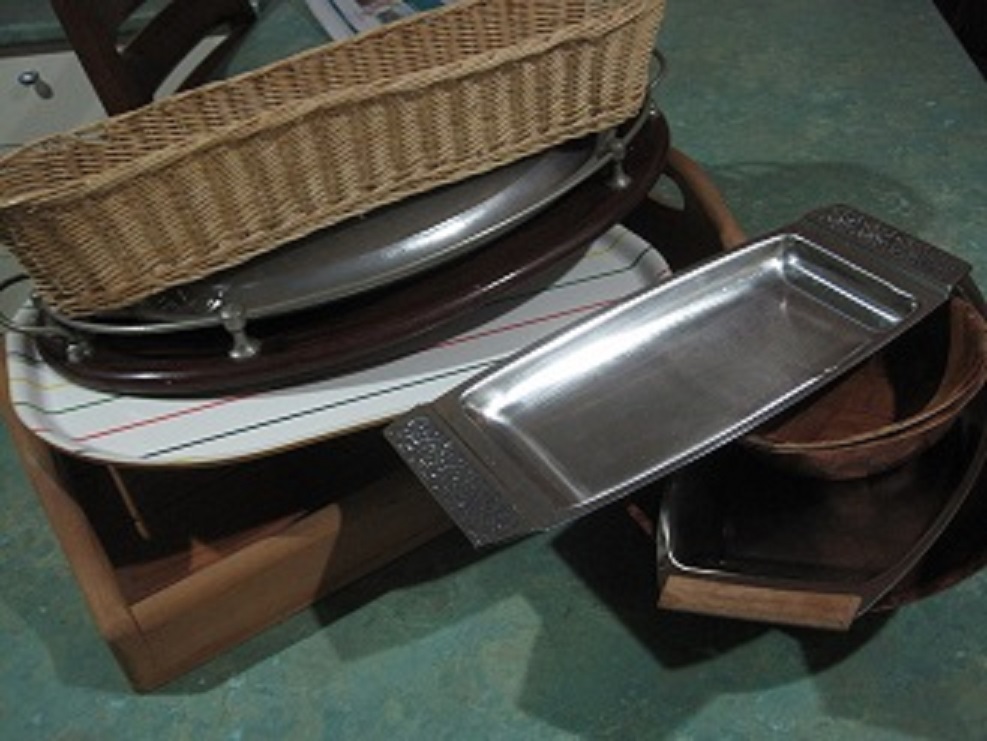
Linen cupboard
Once you set limits on your stuff and force yourself to choose, you will naturally choose ‘the best’.  How you make that choice is a personal decision but making the choice means that you consider the merit of each piece carefully and you will appreciate its worth to you and your life.  The stuff that makes the cut will have an opportunity to shine in the decluttered environment.

It is not only physical stuff that you can set limits on.  You can set limits on your participation in events.  For example, you may decide that you will only spend one night a week playing sport, therefore you will choose the one you enjoy most.  This may give you a chance to excel rather than putting in a mediocre performance in 3 different sports on 3 different nights of the week.  You may choose to limit your association with people who do not enhance your life.

Limits can be seen as restrictive but the limits you set on your stuff will actually be liberating as you are the one making the choices.  Don’t let your stuff rule you and your life.

STREAMLINE – Modules

3 Comments

Today I want to share the next step in the ‘Streamline’ process that is outlined the book, “The Joy of Less”.

Make-up module

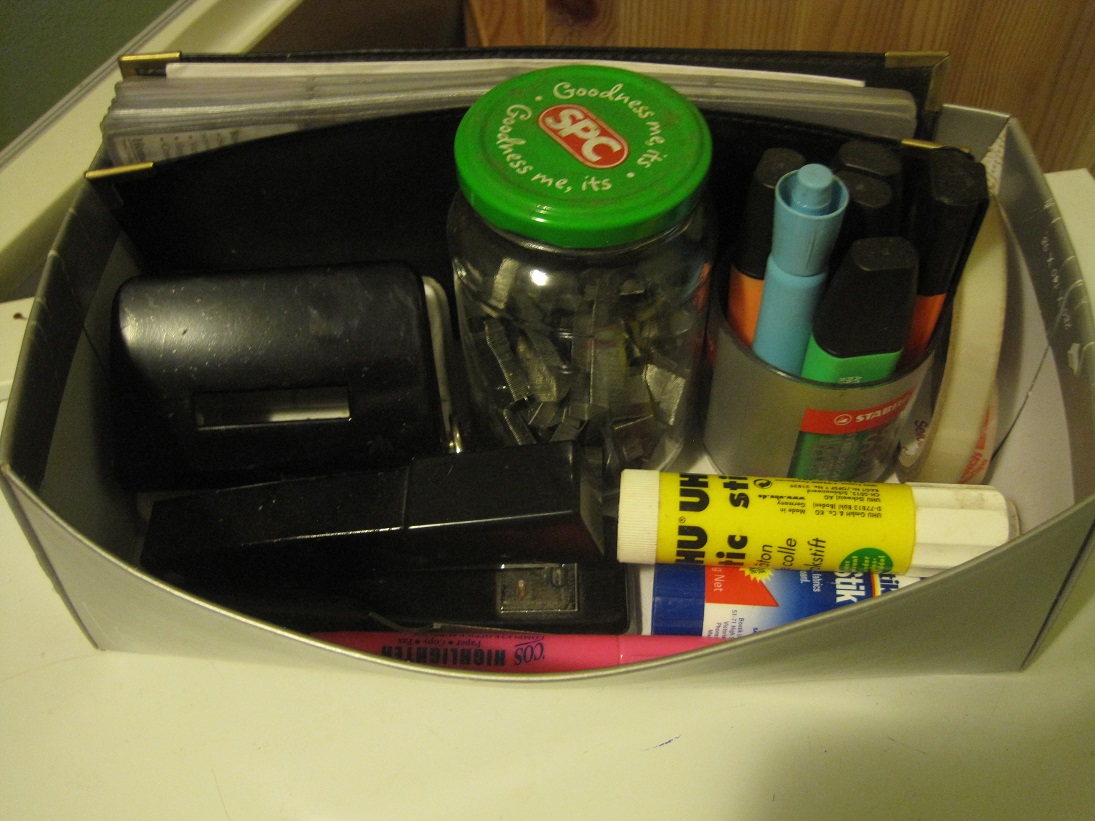
The concept of modules is that like things are kept together but more than that, it is about creating a group of items required for a particular task or activity.  It could be keeping your knitting needles, wool and pattern all together in one basket so that you can pick up your knitting at any time and know that it is all there.  Perhaps, creating a bill-paying station where you have all of the items required such as pens, stapler, filing box etc.

By keeping like items together this method helps you to identify where you have an unnecessary duplication of items.  An example is pens:  If you have them lying around on various desks, drawers, kitchen bench, side tables etc it is difficult to understand just how many there are.  Gather them up, check to see which ones don’t work (there will be some),and place them all together.  So, do you really need 57 pens?  They last for ages and you probably have more than a lifetime’s supply!  Choose the best 10, keep them together in a convenient and confined spot.  47 pens that have been lying around the house as clutter are gone!!

Once you start thinking in terms of modules you can apply the principle to almost anything in and around your home.

On the weekend, The Duke and I spent quite a bit of time decluttering, sorting and organising the workshop.  It is definitely a work in progress but now we can actually see some of the half-finished projects that had been buried under other things, completely forgotten or simply unable to be worked on due to the clutter on the workbench.  Much of what we did was putting like with like.  There were pieces of baling twine which we keep for various odd jobs.  It seemed like everywhere I turned there was another bit of baling twine but they are now all together in one plastic bag and easy to find when we need a piece.

We have almost finished demolishing the old chicken run and this has entailed removing the side of the woodshed which was adjacent to the run.  The woodshed will remain and a new side panel built to keep the weather out and the wood dry.  This has prompted us to look critically at all of the various piles of wood – everything from tree branches to leftover material from previous building projects.  We are attempting to get all of the suitable firewood in one place in the woodshed so that we can easily access it when needed in the winter months.  One day the firewood ‘module’ will be complete!

The wood is currently in piles to be cut for firewood, stored for future projects or simply of no use and needs to be re-homed or dumped.

Modules create efficiency and also limits.  Whilst the STREAMLINE process is most definitely NOT about rushing out and buying a whole lot of pretty boxes to stash your stuff in, it does help to be able to physically contain your identified ‘modules’.

Stationery module

You probably have ‘modules’ that work for you but that you have not even described as such.  Please share your idea and what works for you.

LIMITS is the next in the series and follows on very neatly from today’s topic.