STREAMLINE – Everyday Maintenance

3 Comments

After you have worked through all of the other steps in the ‘STREAMLINE’ process, it is important not to lapse back into old ways.  Just like changing eating (or any other) habits, if your version of minimalism is to be successful it needs to be an ongoing process.  You will have to work at it constantly and be vigilant at every turn.  Clutter in all its forms is insidious and will soon overwhelm you if you do not have strategies in place to stop it at the door, the mailbox and even your email inbox.

Well-meaning friends and relatives may feel sorry for you when they see your empty spaces and want to give you stuff to fill the gaps.

You did not set out to create a cluttered, over-burdened life – it just happened.  So, it could easily happen again.

“No, thank you” is one of the most powerful things you can say in your quest to keep your stuff at the level which suits you best.  Whether it is a freebie bag at a conference, a loyalty card from a store, a copy of recipe or your great aunt’s tea-set – if it does not fit your goals you can politely refuse the offer.

Dining table

I have refused, decluttered and minimised for several years and still know that there is more to go.  I keep a bag/box in the spare room and as I find things to go they are moved to the box which then goes to the op shop when it is full.  Sometimes it takes ages to gather enough to send off and other times there is a flurry of activity and I take several bags in one weekend.  Having a dedicated receptacle for things that are to be re-homed helps me to keep focused.

I hope you have enjoyed this series and would strongly recommend reading “The Joy of Less” by Francine Jay for more inspiration.  Please share your thoughts on decluttering and minimalism in general and as well as your personal achievements.
STREAMLINE – Narrow it Down

Leave a comment

This is where it starts to get really challenging.  Now we need to ask ourselves the question, “What is the minimum that I need to live?”  Francine notes that you do not need to worry that you will be expected to sleep on the floor or live in a tent but you do need to challenge yourself.  It is not enough to wave your magic wand and say that you need everything that you have.

There is no magic number of items or even a formula that you can apply.  Everyone’s ‘enough’ is different.  It can depend on your location, family, children, hobbies, upbringing and experiences.

Embracing minimalism is a personal choice.  It is not about depriving yourself but giving yourself the freedom to live and enjoy the moment.  There is a liberating lightness which comes from letting go of possessions so take the time to look around you and decide what you can live without.

Contents of cupboard

Some of things you could consider when attempting to narrow down your possessions:

  • Duplicates – these are easy – you don’t really need 2 (or more) do you?
  • Sentimental stuff – Francine suggests ‘minituarising’ as a way of dealing with these – an example could be a place card, photo, swatch of dress fabric and a dried flower from the bouquet all in a simple frame as a wedding memento rather than keeping a wedding dress and all the trimmings.
  • Digitising – scanned photos in files on the computer rather than shelves full of albums that gather dust.  If the digitised files are well catalogued they are actually more accessible than hard copies.  You can also keep back-ups in different locations in case of disaster.

I do not purport to be perfect in any of these ways but am certainly working on it.  What about you?

STREAMLINE – If One Comes In, One Goes Out

4 Comments

This is a fairly simple strategy – for every item that you welcome into your home another one needs to leave.  Whilst this strategy will not turn you into a minimalist overnight, it will certainly maintain the status quo.

One of the most popular applications of the ‘one in, one out’ rule is clothes.  Buy a new shirt and then choose one that you can move on.  If you are having trouble letting one go, perhaps it is time to ask yourself why you bought the new shirt in the first place.  Did you really need it?  The last time I looked, we can only wear one shirt at a time so why do we need a wardrobe bulging with clothes?

Appliances are another area where we can tend to buy a new version yet retain the old one.  It is usually consigned to the back of the cupboard or the garage ‘just in case’.  Just in case the bright new shiny one breaks down?  Do we really buy things expecting them to fail?  If the previous one needed replacing it is time for it to go.

We recently purchased a new refrigerator.  After a considerable time spent looking and debating the various options available this is the one we bought.

RefrigeratorOf course, there was the question of what to do with the old one.  The Duke briefly canvassed the option of keeping it downstairs as a ‘beer fridge’ but we realised that it was completely unnecessary and would use up space and electricity.  I advertised it on Freecycle and am pleased to say that it has gone to a young couple who were trying to set up a home with very little in the way of resources.

Old refrigerator

Most of us live in relative affluence and virtually everything we buy is an upgrade/replacement/newer version of something we already own.  Therefore, there will be something to move out of your home.  If the previous item was broken it should be consigned to the rubbish/recycling.  If it is still functional someone else may benefit from having it.  No-one benefits from it being stashed away to deteriorate in your garage or basement.

As an aside, I find this principle of ‘one in, one out’ a fantastic disincentive to shop.  “Why spend my hard-earned cash on something when I have a perfectly good one at home?” is the question I often ask myself.

How effective are you at ‘one in, one out’?

STREAMLINE – Limits

5 Comments

In years gone by our stuff was limited to a large degree by the availability and cost of most items.  Goods were generally produced locally and in a relatively labour-intensive manner.  Disposable incomes were less and stuff cost more when compared to incomes.  Global manufacturing and transport, cheap labour and distribution have meant that there is a seemingly endless supply of stuff for you to purchase at your local shopping mall.

Since the natural limits of accessibility and affordability have been removed, it is up to us to take control or we will end up drowning in our stuff.  The ultimate limit is the size of your home; you can fit a lot more in a 2 storey, 4 bedroom family home than a studio apartment.  However, even this does not deter some people as evidenced by the burgeoning industry of off-site storage facilities.

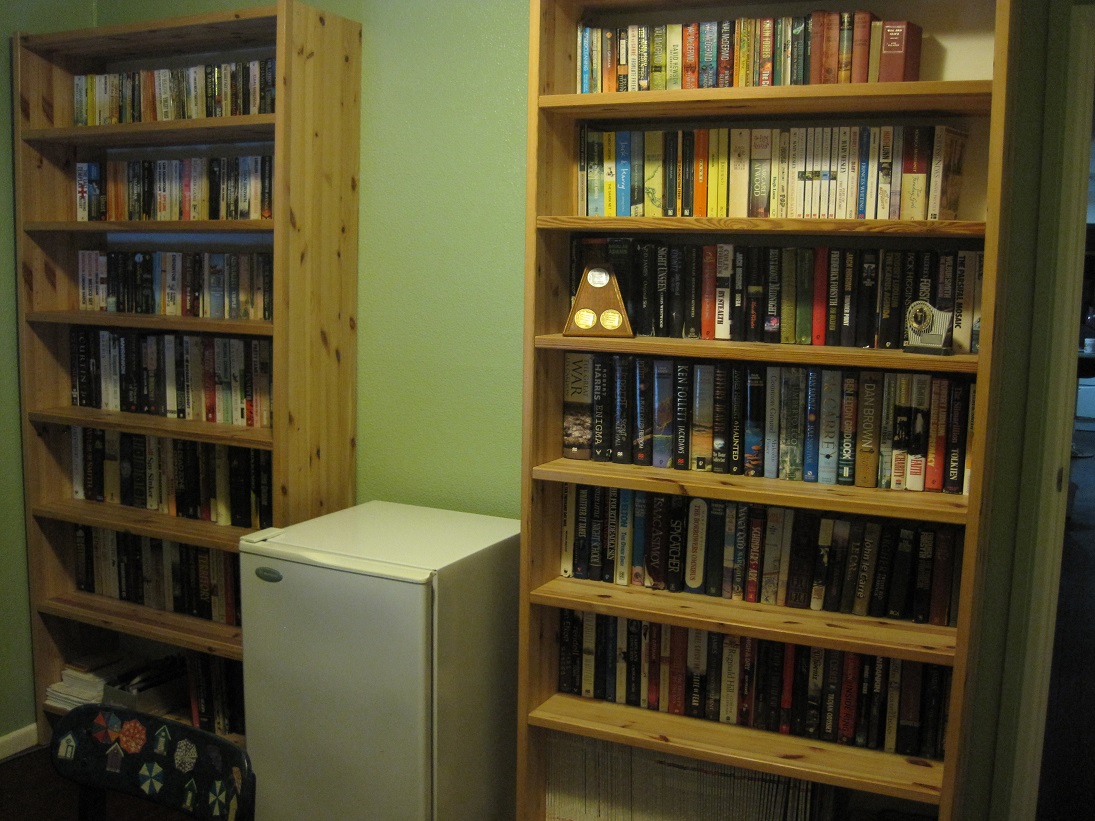
You can easily apply limits to things like your books by simply choosing not to have the shelves overflowing.  As you buy or acquire new books, make space for them by moving others along.  We all have books that we are not sure why we are keeping them.  Will you read them again?  No?  Time to go.  This way you will eventually end up with a selection of books that you really love and are proud to have on your shelves.

Bookshelves
Perhaps you can choose an arbitrary number such as 20 DVDs, 10 t-shirts or 6 champagne flutes.  Make sure that you don’t simply choose a number that allows you to maintain the status quo.  It needs to be challenging yet achievable as well as pertinent to your unique situation.

No matter what the item, you need to ask yourself the question, “Do I really need x of this item?”  Nothing needs to be immune from this process – lipsticks, plates, socks, CDs, towels, candles and cookbooks are all fair game.

Linen cupboard
Once you set limits on your stuff and force yourself to choose, you will naturally choose ‘the best’.  How you make that choice is a personal decision but making the choice means that you consider the merit of each piece carefully and you will appreciate its worth to you and your life.  The stuff that makes the cut will have an opportunity to shine in the decluttered environment.

It is not only physical stuff that you can set limits on.  You can set limits on your participation in events.  For example, you may decide that you will only spend one night a week playing sport, therefore you will choose the one you enjoy most.  This may give you a chance to excel rather than putting in a mediocre performance in 3 different sports on 3 different nights of the week.  You may choose to limit your association with people who do not enhance your life.

Limits can be seen as restrictive but the limits you set on your stuff will actually be liberating as you are the one making the choices.  Don’t let your stuff rule you and your life.

STREAMLINE – Modules

3 Comments

Today I want to share the next step in the ‘Streamline’ process that is outlined the book, “The Joy of Less”.

Make-up module

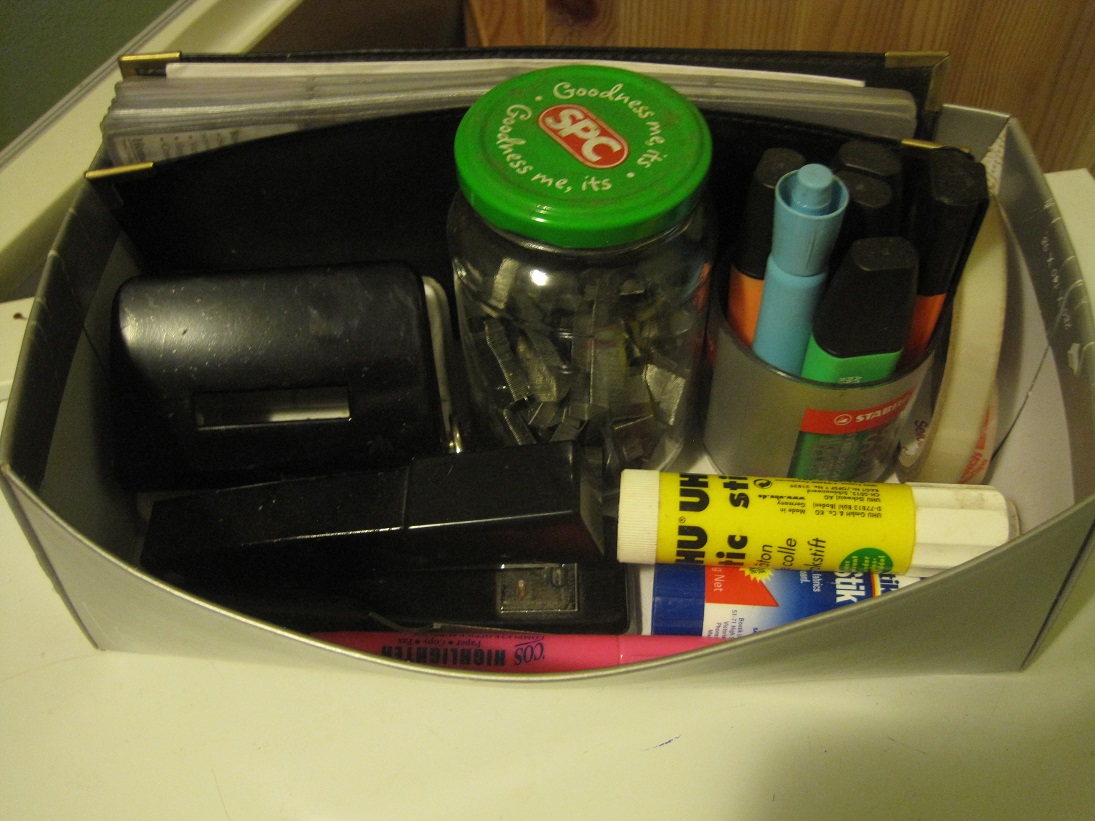
The concept of modules is that like things are kept together but more than that, it is about creating a group of items required for a particular task or activity.  It could be keeping your knitting needles, wool and pattern all together in one basket so that you can pick up your knitting at any time and know that it is all there.  Perhaps, creating a bill-paying station where you have all of the items required such as pens, stapler, filing box etc.

By keeping like items together this method helps you to identify where you have an unnecessary duplication of items.  An example is pens:  If you have them lying around on various desks, drawers, kitchen bench, side tables etc it is difficult to understand just how many there are.  Gather them up, check to see which ones don’t work (there will be some),and place them all together.  So, do you really need 57 pens?  They last for ages and you probably have more than a lifetime’s supply!  Choose the best 10, keep them together in a convenient and confined spot.  47 pens that have been lying around the house as clutter are gone!!

Once you start thinking in terms of modules you can apply the principle to almost anything in and around your home.

On the weekend, The Duke and I spent quite a bit of time decluttering, sorting and organising the workshop.  It is definitely a work in progress but now we can actually see some of the half-finished projects that had been buried under other things, completely forgotten or simply unable to be worked on due to the clutter on the workbench.  Much of what we did was putting like with like.  There were pieces of baling twine which we keep for various odd jobs.  It seemed like everywhere I turned there was another bit of baling twine but they are now all together in one plastic bag and easy to find when we need a piece.

We have almost finished demolishing the old chicken run and this has entailed removing the side of the woodshed which was adjacent to the run.  The woodshed will remain and a new side panel built to keep the weather out and the wood dry.  This has prompted us to look critically at all of the various piles of wood – everything from tree branches to leftover material from previous building projects.  We are attempting to get all of the suitable firewood in one place in the woodshed so that we can easily access it when needed in the winter months.  One day the firewood ‘module’ will be complete!

The wood is currently in piles to be cut for firewood, stored for future projects or simply of no use and needs to be re-homed or dumped.

Modules create efficiency and also limits.  Whilst the STREAMLINE process is most definitely NOT about rushing out and buying a whole lot of pretty boxes to stash your stuff in, it does help to be able to physically contain your identified ‘modules’.

Stationery module

You probably have ‘modules’ that work for you but that you have not even described as such.  Please share your idea and what works for you.

LIMITS is the next in the series and follows on very neatly from today’s topic.

Doing, Not Writing

Leave a comment

I apologise for the lack of posts in the past few days.  I have been busy here doing some decluttering and organising so have not had time to write about it.

Please bear with me and I promise I will be back soon with the remainder of STREAMLINE.  We are up to M for Modules.

I will also be able to share what I have been doing and how it has made things better here.  I am looking forward to hearing your own decluttering experiences.

STREAMLINE – All Surfaces Clear

2 Comments

Today’s gem from Francine is pretty simple to say but not quite so easy to achieve.  Keep all surfaces clear.  Clear surfaces provide us with possibilities.  Somewhere to eat your dinner, prepare a meal, pay bills or simply to sleep.

She also reminds us that surfaces are not for storage.  If you have too much stuff for your available storage spaces perhaps it is time to let some it go.

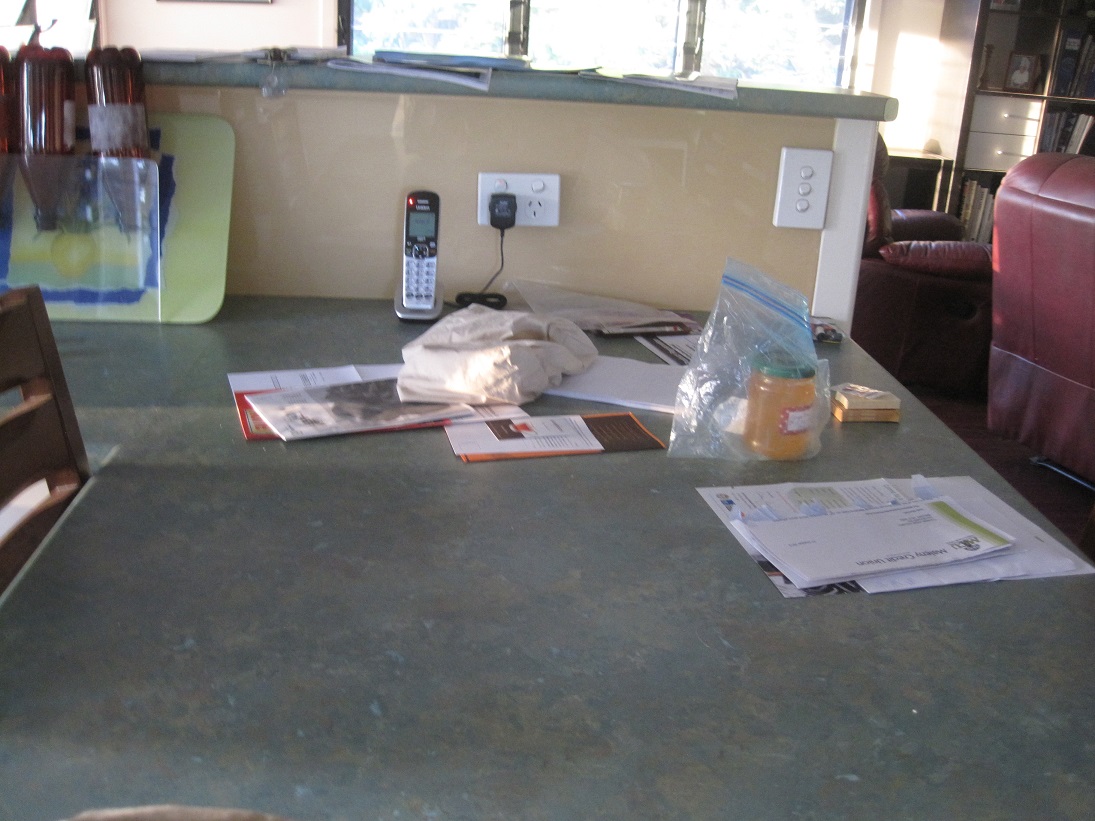
This is one area with which I have had partial success.  For instance, my dining table always is clear apart from a doyley and vase which provide a decorative element.  I am also pretty good at keeping the vanity bench in the bathroom as well as the laundry bench clear.

Dining table

The study desk is generally a failure and the kitchen benches range from good to bad depending on the day of the week and work in progress.

Kitchen bench

It takes time and effort to achieve the state of a completely clear surface.  Like all changes you need to start small.  Don’t expect to turn the study desk which is overflowing with stuff into a minimalist’s paradise overnight.  If you have sufficient storage in the bathroom, I think the vanity bench is a great place to start.

The dining table is also a good one to tackle because anything that is on here is definitely in the wrong place – a dining table is to sit at to eat a meal.  Since most of us eat 3 meals a day there are plenty of opportunities to make sure that it is clean, clear and ready for use.  Since it is also a public part of your home everyone will benefit from it being clear and ready to use for its designated purpose.

Please let me know – do you have any constantly clear surfaces of which you are particularly proud?  What are the areas that seem to defeat you?

Tomorrow we will move on to something a bit more interesting than my kitchen bench.  Modules – containing what you have.  It is definitely a new twist on rushing out and buying containers to store your stuff.

STREAMLINE – Everything In Its Place

11 Comments

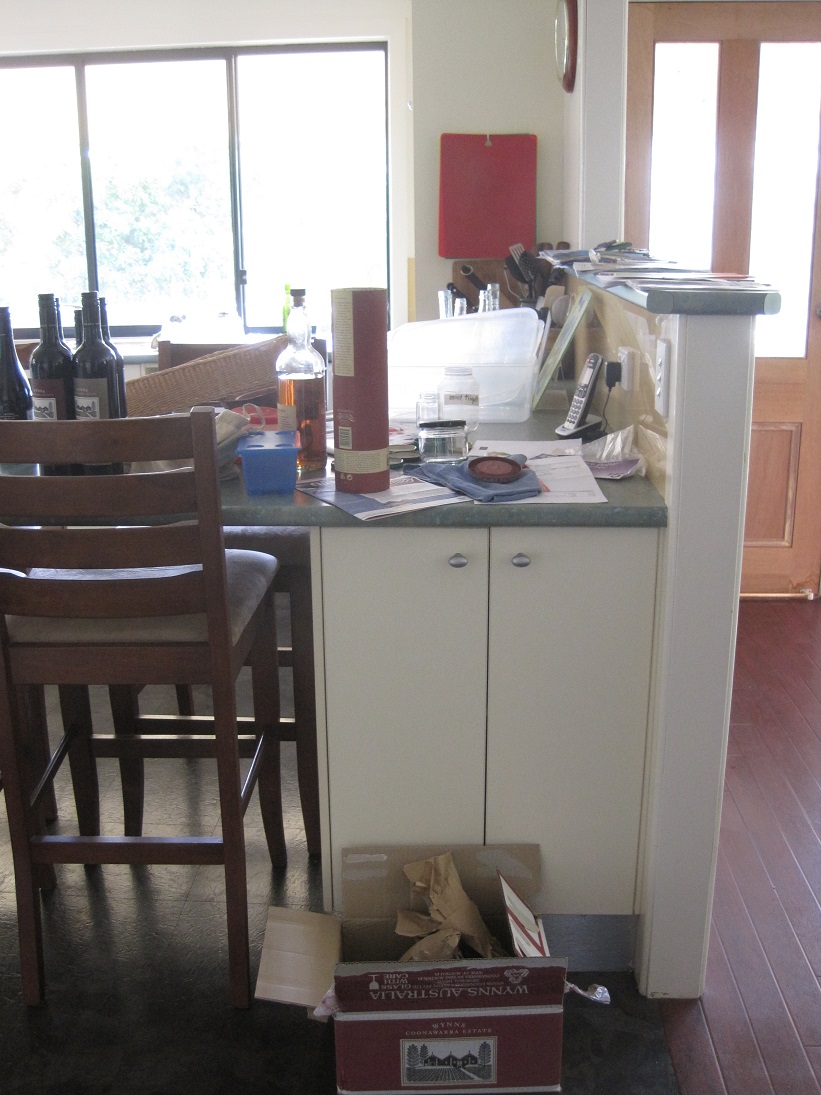
Just to prove that I don’t always live up to what I write here is a photo of my kitchen bench this morning.

Kitchen bench
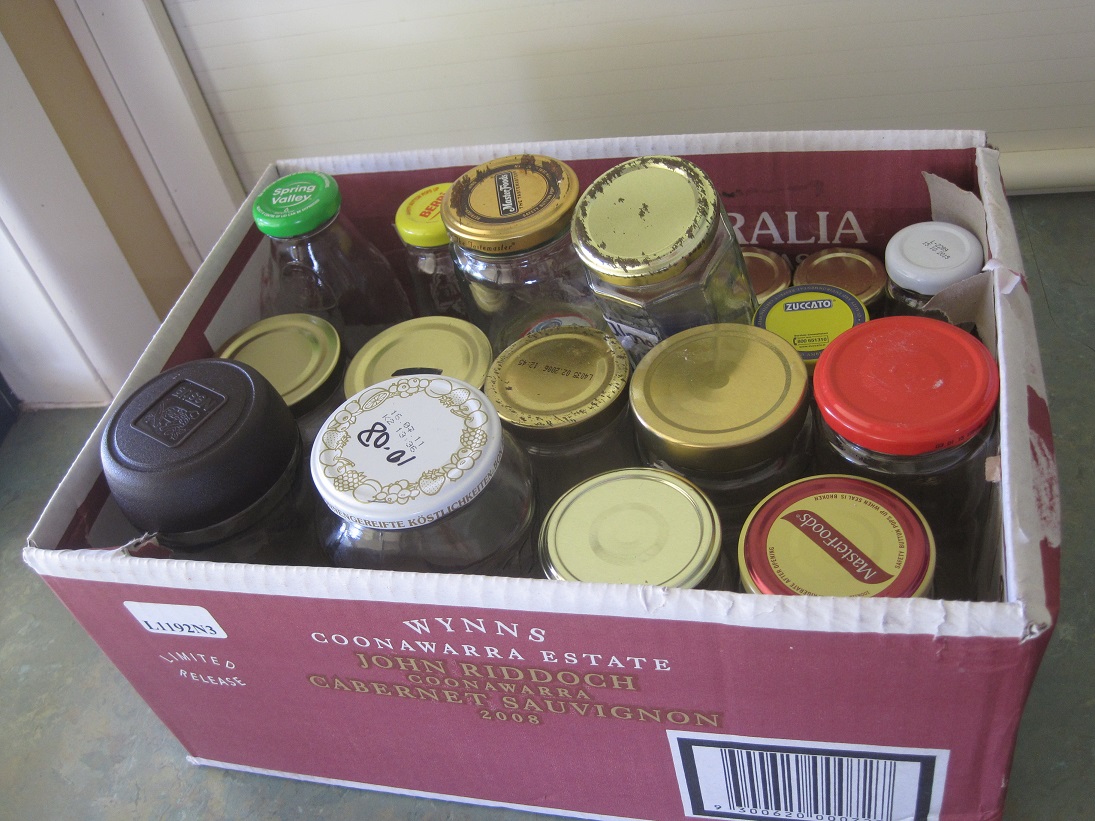
Well, everything was certainly not in its place.  Saturday morning is not usually the best time at our place.  We have both had a long week at work and despite the best of intentions, I have usually run out of steam be the time I get home.  The empty box on the floor and the wine on the bench were part of a delivery of purchases made by The Duke while we were away the other week.  There is an assortment of paperwork that had not been dealt with  as well as some clean dishes and numerous glass jars and bottles.

So, what is their place?

The packaging from the wine has gone into the recycling.  The box was repurposed to hold some jars that I have listed on Freecycle.  The paperwork has been sorted into recycling and a pile to be filed.

I keep 2 plastic tubs of jars in my pantry.  One holds the ones which have pop-top lids which I use for preserving and the other tub has an assortment which I keep for storage etc.  There were too many jars so it was time to cull them and keep only the best ones.  I only keep about 4 different style/size of jars with pop-top lids so that I can use a consistent size when making something like pasta sauce.

Preserving jars

The excess jars have been listed on Freecycle but if no-one wants them I will drop them off at the op shop.

Excess jars

The wine has been relocated to the wine rack storage in the cellar.  Alas, it is not strictly a cellar in the true sense of the word but it is downstairs and maintains a fairly even temperature.  The Duke and I took the opportunity to tidy up and sort out the contents of the rack.  It is now in a more logical sequence and hopefully we will easily be able to locate what we are looking for in future.

As usual, one thing led to another and I now also have some excess coffee mugs to take to the op shop as well as 2 low folding chairs to put on Freecycle.  The less stuff we have, the easier it is to keep everything in its place.

STREAMLINE – Trash,Treasure or Transfer

12 Comments

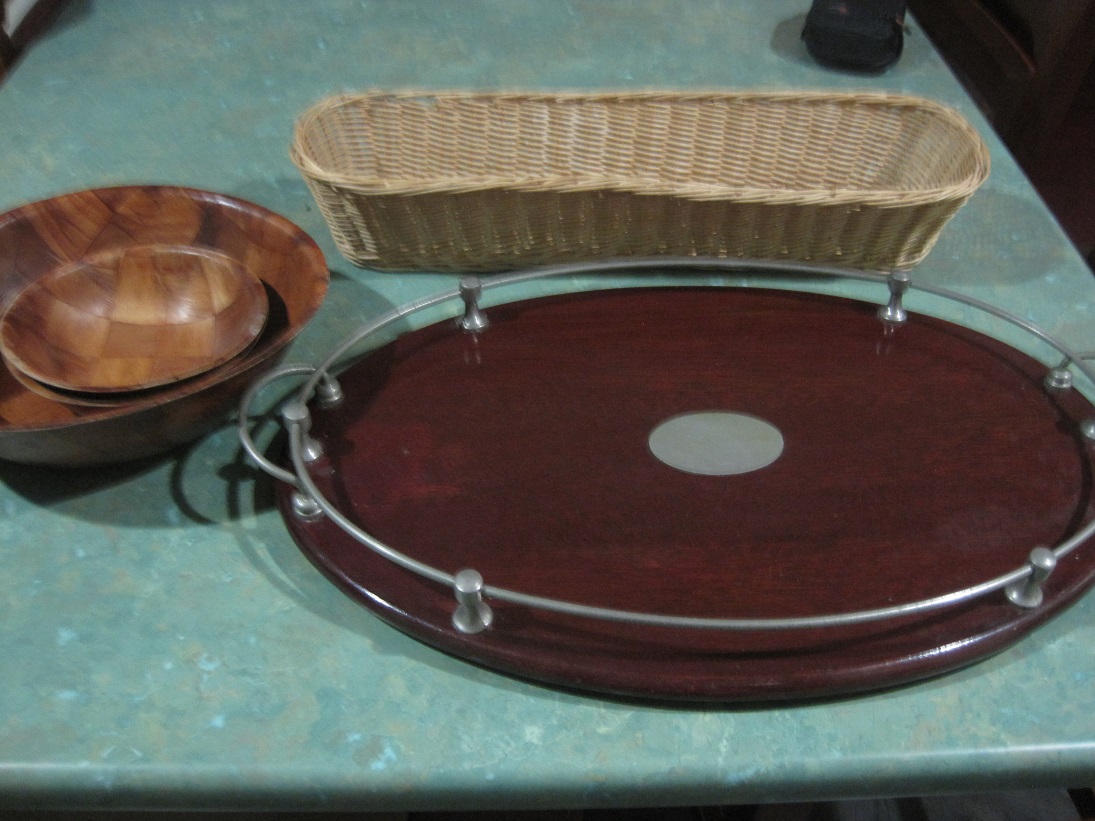
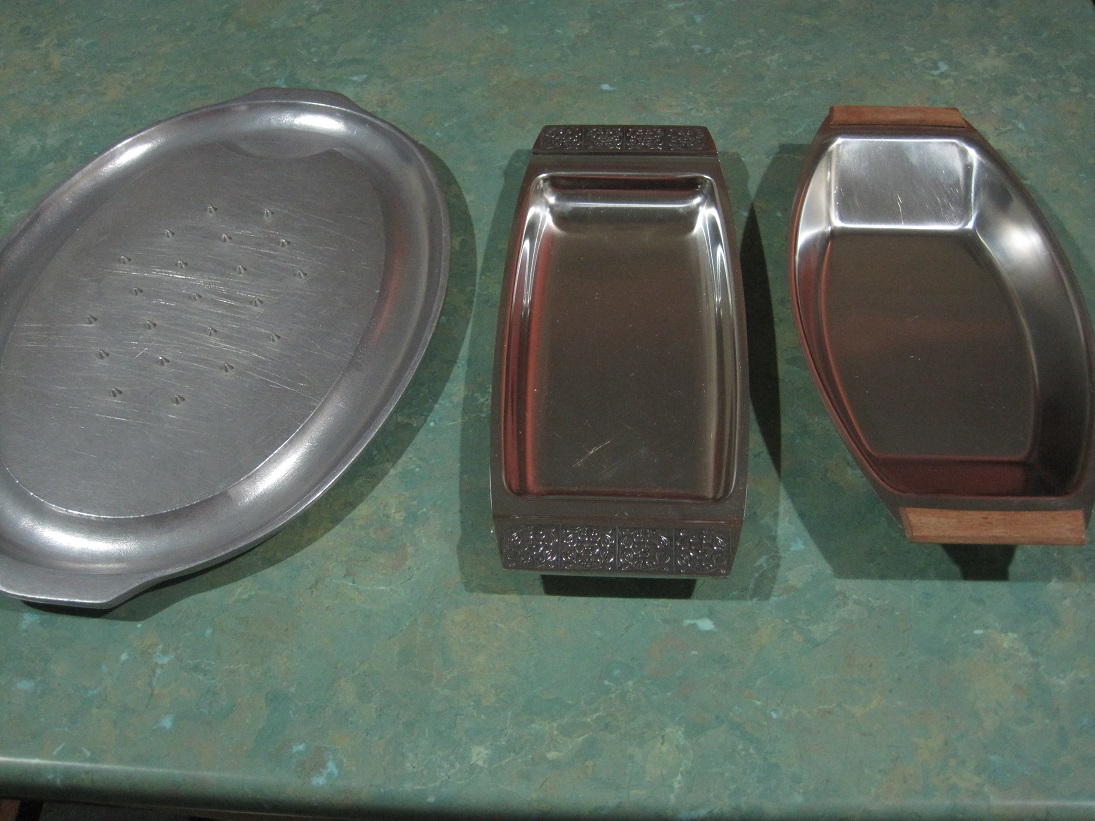
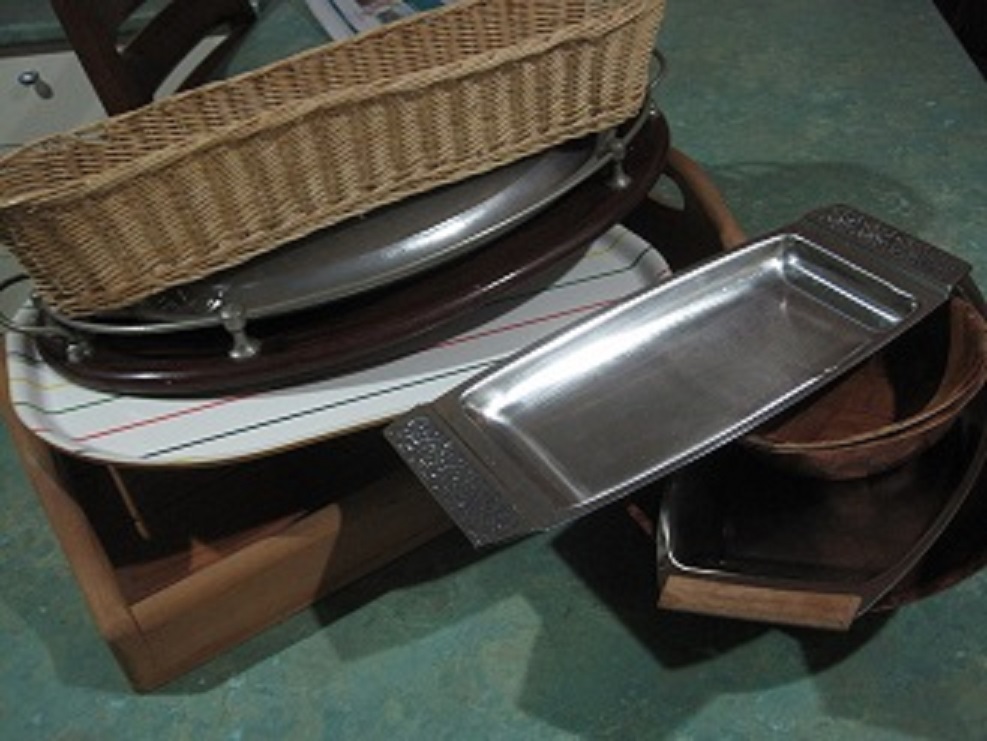
Now you have bitten the bullet and everything is out of the room, cupboard or drawer that you have chosen to work on. As I mentioned yesterday, the first thing is to focus on the space you have created.  Although it is not strictly part of the decluttering process, I am sure you will want to clean the space.  Wipe out the cupboard or drawer. If it is a whole room you will probably set aside some time to give it a really deep clean. Notice how easy a room is to vacuum or dust when there is no ‘stuff’ in it.  Keep this in mind and remember that cleaning and general housework become much easier when you are not fighting the ‘stuff’ on a daily basis.  On of the great attractions of a minimalist lifestyle is the reduced time and effort spent on routine housework. Contents of cupboard Time for a bit of show and tell.  This is what was in the cupboard. 3 trays 1 carving platter 1 long basket 2 serving trays 3 bowls These items have been part of our household for many years.  They all fitted in the cupboard easily and were only used rarely.  Without the prompt of the doors being opened frequently (which I discussed yesterday) inertia would have dictated that the status quo remain.  However, when I took them out of the cupboard (their comfort zone) and laid them on the bench I saw them in a different light. TRASH – nothing went in the rubbish as these are all perfectly functional items.  However, I needed to decide what would be transferred – that is – rehomed. The easiest decision was the long basket.  This was used for serving a baguette cut and prepared as garlic bread.  How very 70’s!  I cannot remember the last time I served bread in this manner yet the basket lived on.  I have other containers which would do the job admirably if I ever serve bread with a meal in the future.  Since I eat a gluten-free diet that is fairly unlikely. The 3 wooden bowls also screamed 70’s, and while there is nothing wrong with that, it does give you an idea of how long they have been lurking around.  The set originally included the large serving/salad bowl and 4 smaller bowls.  There were also a set of salad servers which, from memory, were fairly useless.  The large bowl is somewhat misshapen but still is used occasionally for serving potato crisps or corn chips in a party situation.  This was useful when there were young children around as it is unbreakable, however, I have plenty of other options.  Time to move these on. The most difficult was the timber tray because of the sentimental value.  It belonged to my grandparents and it was one of several items that I chose to keep after my grandfather died (over 25 years ago).  There were 2 other trays in the cupboard and I knew that I could not justify keeping all 3 of them as they are rarely used.  This was the least practical as it is oval and has very little capacity for carrying things which should be its prime purpose so it was time to say goodbye. Transfer pile What made the cut? Trays These 2 trays are being kept.  The wooden one is a practical item for taking food and utensils from the kitchen to the outdoor eating area.  I do not use it enough and I have reminded myself of its existence and will use it more often in the future.  The striped tray is not all that good for carrying things as it has not defined handles nor sides and is quite slippery.  However, it can be used as a large,unbreakable serving platter so it stays for now. Other stuff The carving tray belonged to my parents and is used occasionally.  The other criteria when decluttering is whether an item could easily be replaced in the future.  I do not believe that this could be replaced by anything approaching the same quality, therefore it definitely stays. Finally, the 2 stainless steel serving trays are used on a semi-regular basis for social afternoon teas to serve sandwiches, slices or cake.  The fact that they are not breakable makes them a good choice for ‘bring a plate’ events as well. The result?  5 items to go and 5 to stay.  I have halved the contents of one cupboard and know that I will not miss the ones that go.  I also know that I am more likely to use the remaining items more often since I have clearly identified the reasons that I have them. I hope this has helped you in your own attempts to sort out the trash, treasures and things to transfer. You need to make sure that complete the task by actually putting the rubbish (if any) in the bin and moving the transfer items on to their new homes.  That may be via eBay (or similar), Freecycle or the local donation bin. I would love to hear how you go. In this post I have actually addressed the “R  – Reason for each item” as well. Tomorrow – “E – Everything in its place”.

STREAMLINE – Starting Over

6 Comments

As promised, here is the first in my decluttering series based on “The Joy of Less” by Francine Jay.

Whether it is a whole room or a single drawer, the principle of this step is to start from scratch.  That is, you need to get the space back to how it was when you moved into the house.

If you leave things in place this activity becomes one of cleaning around items rather than seriously questioning the value of every single piece.  As Francine says, “Nothing gets a free ride”.

Are you about to give up before you even get started?  Does the prospect of removing everything fill you with terror?  Or are you thinking that you have nowhere to put the stuff until the next step of “Trash, treasure or transfer”?  You have made it this far so I expect that you have some very good reasons for wanting to declutter.

Perhaps you could start small and tackle one drawer.  Empty the entire contents onto the kitchen bench.  Don’t focus on what is on the bench.  Give the drawer your entire attention.  Clean it inside and out.  Replace it and feast your eyes on the space.  Space to hold the things you really need and love.  Now, close the drawer and turn your attention to the pile on the bench.  Would you simply toss all of this back in the clean drawer?  Now it is time for “T” – “Trash, treasure or transfer” but more of that tomorrow.

There is no specific order in which to tackle the decluttering.  You could try the most-used room, or the least.  Perhaps the worst area or one that causes you the most personal angst.  It could be you bedroom so that you have a calm and peaceful retreat from the chaos around you or the entry area so that you are thrilled to greet visitors.  Whatever you decide, it is your choice.

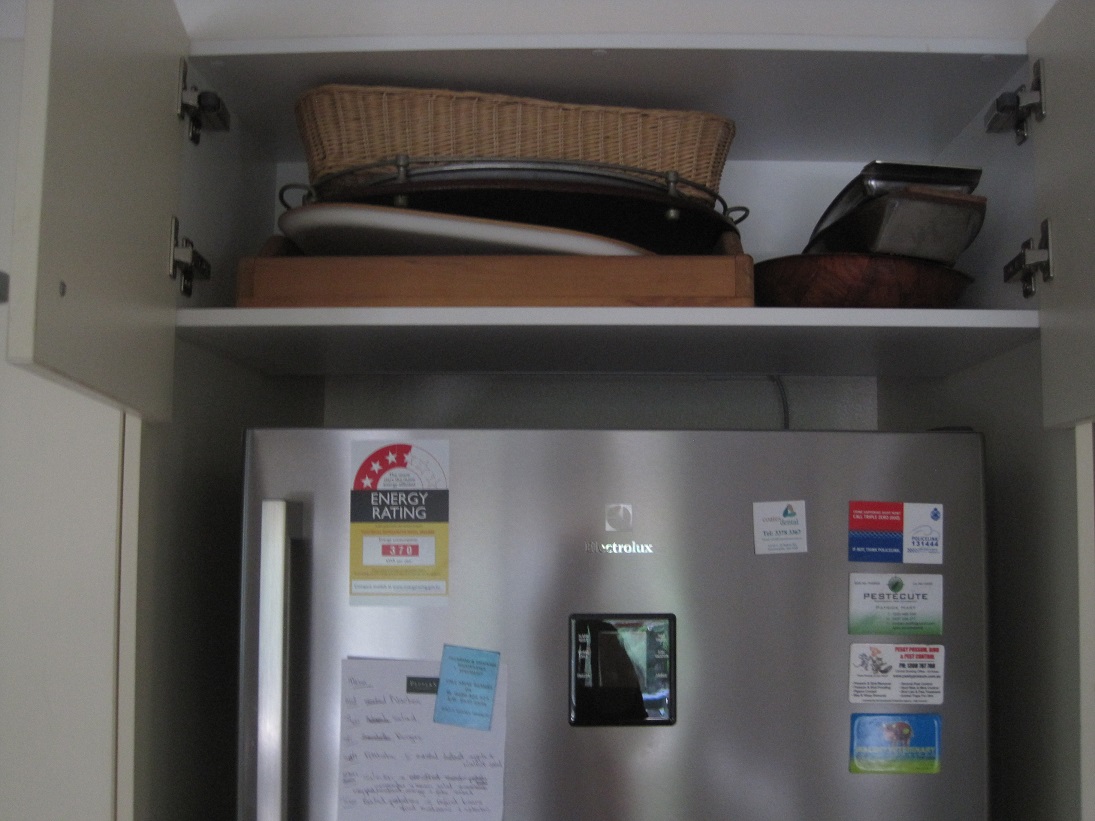
I have chosen a small space – the cupboard above the refrigerator.  This sees very little activity usually but it has been opened several times a day over the past week.  You see, we have a new refrigerator which fits easily in the available space, however, the doors on the overhead cupboard were custom-made to suit the old refrigerator so they need to be opened every time we go to the refrigerator at the moment.  The cabinetmaker is coming on Friday to remove and modify the doors.  Having this cupboard opened regularly has reminded me of what I have stashed in there and how infrequently it is used so I have decided it is time to take everything out and have a serious look at why it is there.

Overhead cupboard

What are you going to tackle first?  I am looking forward to hearing of your choices, successes and challenges.

Tomorrow,  we will get right into it.