Six months ago I watched on wistfully as my Northern Hemisphere blogging friends struggled to bottle, preserve and freeze their abundance of tomatoes. It was winter here, and although the ground is not covered with snow, it was far too cool to be thinking about growing tomatoes, let alone harvesting them. I hoped that my turn would come, and sure enough, it has.
A couple of weeks ago I made tomato sauce and blogged about it here.
As well as the wild cherry tomatoes we are growing Roma tomatoes for the first time and they have been a runaway success. The next tomato project I decided to try was tomato paste. As usual, I found several recipes on the internet, compared them and then made it to fit my available ingredients and quantity of tomatoes. The site which I referred to most is here. You will see that I used much less oil than suggested. Also, please remember not to mix up pounds and kilograms. I used 5 kgs which is 11 pounds.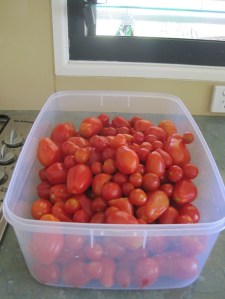 These are 4kg of Roma tomatoes which I picked yesterday.
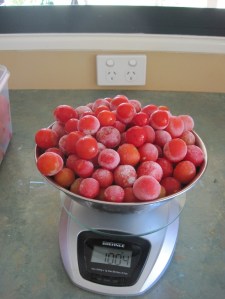 And another 1kg of cherry tomatoes which I had in the freezer.
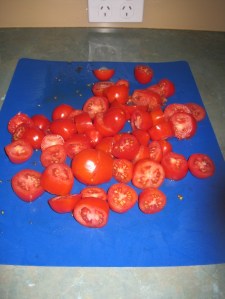 I roughly chopped the Roma tomatoes.
5kg tomatoes, 125ml olive oil and 1 & 1/2 teaspoons sea salt into the stockpot and simmer for about 10minutes.
 Then it is time to put all of the liquid and tomatoes through a food mill.
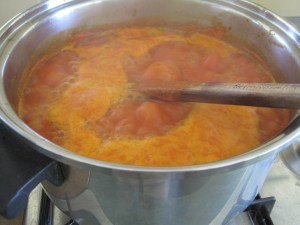 All of the liquid and puree went into a large saucepan and the skins and seeds into a separate bowl to be discarded.
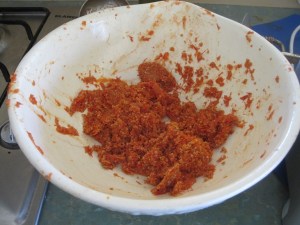 Simmer the liquid for 1 – 2 hours or until reduced and thickened.
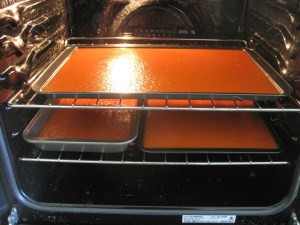 Pour the thickened puree into shallow oven trays and bake in the oven at 180C for 30 minutes and then for another 30 minutes at 140C.
Check the mixture about every 15 minutes and be sure to stir any caramelised bits on the edge back into the middle of the puree.
Transfer the paste to hot, sterilised jars. Be sure to tap the jars to remove any air bubbles as you pack it in. Place the lids on the jars and process in a hot water bath for 30 minutes. For your health and safety, please refer to more detailed instructions about hot water bath processing.
 Remove the jars, allow to cool and check that the vacuum seal is intact before storing them.
 This is an easy but somewhat time-consuming process. It is a great way to be able to store a large quantity of tomatoes for later use. 5kg of tomatoes made these 6 small jars plus a couple of spoonfuls that I have in a container in the refrigerator which will be used in the next day or so.
The harvest continues. Here are more that I picked today and there are still heaps more of the Roma tomatoes on the bushes.
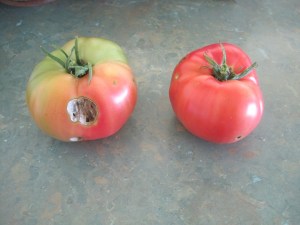
 Finally, here are the first 2 full-sized tomatoes that I have grown for several years with plenty more to come. I cannot remember what variety they are. They have some imperfections but those can easily be removed.
 And one final photo for Mrs Thrift from Not Just Green Fingers who asked how we managed to garden in the heat we are having. I live in an area of Australia where we have a more temperate climate due to the elevation and also a good rainfall. In fact it is sometimes more than we need. However, the last 6 months have been particularly dry and very hot for the past week. The tomatoes and red peppers have coped well but with more hot weather forecast I decided to rig up some protection for them today. The main covering is a large piece of shadecloth which came from my parents’ home. It has timber frames at each end and eyelets in the corners so was very easy to attach to the star pickets at the corners of the fence. The extra piece is an old curtain (very thin) which is covering the peppers.
 Despite the heat we are still managing to produce some of our own food. There are plenty of chillies, we also have figs and peaches. The fruit are unfortunately attacked by fruit fly but I salvage what I can even if it is just one bite. I am going to see if I can rescue enough peaches to perhaps preserve a bottle or two to enjoy in mid-winter. The first cantaloupe was picked yesterday because the side that was touching the ground had started to rot. It was a little early so not superbly full-flavoured but I diced it up and mixed with some locally grown pineapple was very enjoyable for breakfast.
Do you have anything growing in you garden at the moment? How do you cope when you have a glut of a particular fruit or vegetable?
Look forward to hearing your comments.

 I am off to Sydney this week for 3 days for work but more about that next time.


 organised castle