Would You Believe?

8 Comments

I was amazed to realise that it is 3 years ago that I began writing this blog.

3rd birthday

Delving into the records has revealed the following statistics:

I have written 699 posts so this will make make a nice, round 700.  Not a bad effort in 3 years.

There have been 104,013 views of my blog and 2,356 comments in total.

This is not a huge number when compared to some very popular blogs.  However, I made a conscious decision when I began writing that it would not be for the number of followers, views or comments.  Organised Castle was essentially my diary.  It is about living a simple, sustainable life.  In keeping with that goal I was not going to have a blog which was cluttered with widgets, links and advertisements.  The look of the blog is how I live my life.

I am thrilled that so many of you from Australia and overseas keep coming back to read and comment.  I love sharing my thoughts and look forward to continuing the journey.

Thank you.

The Final Step

6 Comments

I read somewhere that doing the washing should not be about putting a load of washing in the machine.  It should be about closing the loop, that is, washing should include the full process of getting worn and grubby clothes back to a state where they are ready to be worn again.  Therefore, hanging them on the line to dry, bringing the dry washing in, sorting, folding, ironing and putting away the clean clothes should all be included in the process.

From my observations, ironing and cleaning the oven seem to be in a class of their own when it comes to the universal dislike of jobs.  I actually do not mind ironing but sometimes find it difficult to find the time as I prefer to do the whole lot in one go.  Due to our streamlined wardrobes I cannot leave it for too long as then we would have nothing to wear so on the weekend I did a spot of procrastinating which masqueraded as organising.

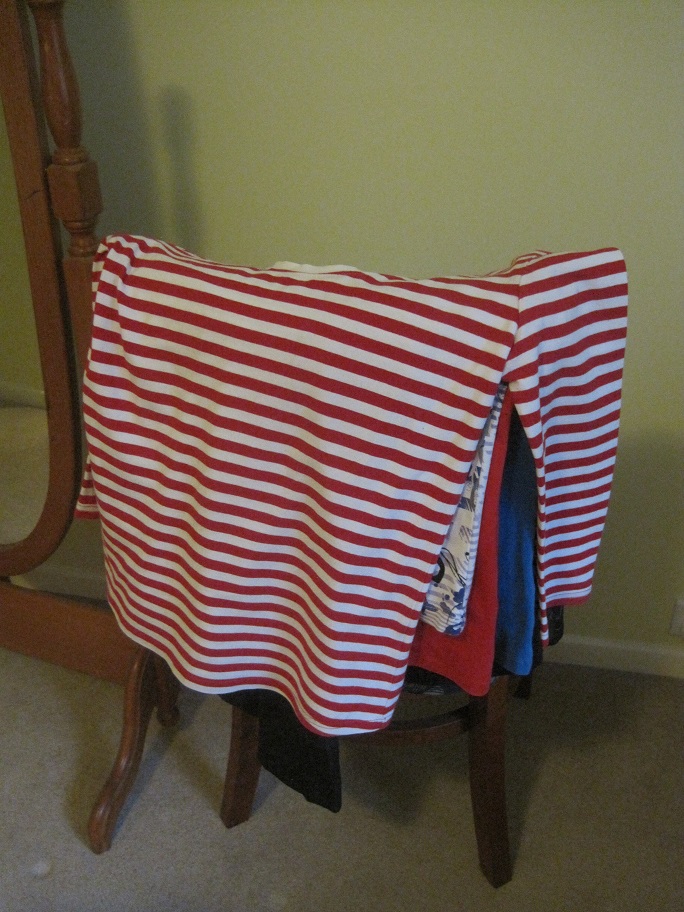
Hanging rack
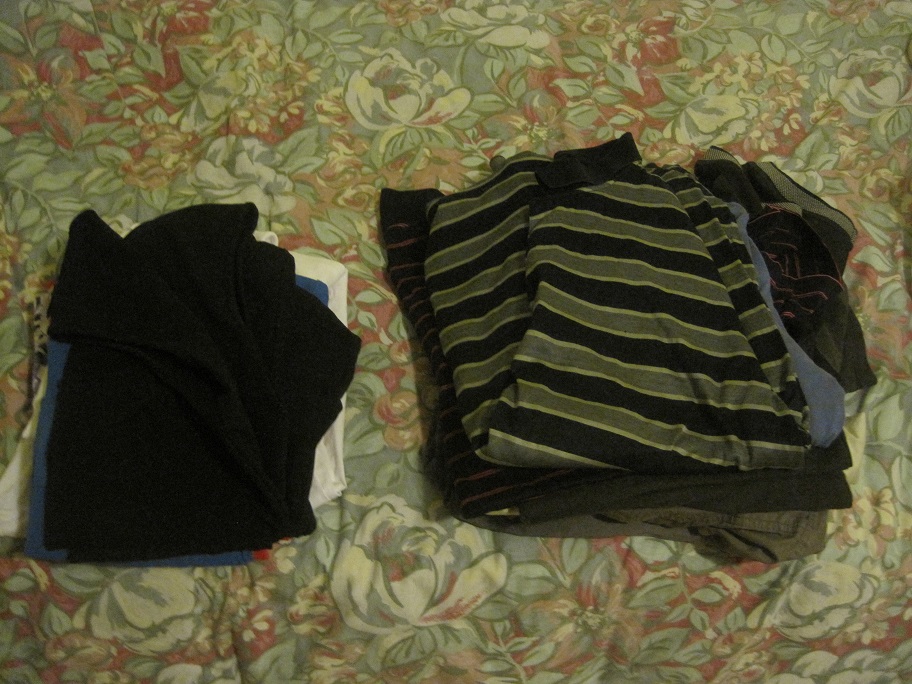
I have a hanging rack where I hang the clothes once they are ironed but I decided to hang them before ironing so that I could see exactly how much I had to do and could easily fetch the next item as I was ready.  I also sorted the things that do not go on hangers into a pile of mine and a pile of clothes belonging to The Duke as well as linens and handkerchiefs in a separate pile.

Piles of ironing
I did the ironing early this morning and found that my procrastination strategy actually paid dividends.  I find it easier and quicker to get into a rhythm of ironing the same type of item – I do all of the shirts or all t-shirts in one go.  By having things sorted I saved time.  I also decided that I would place all of the t-shirts together once they were ironed and then fold them up at the end of the session.  This saves time by not disturbing the rhythm as well as saving money.  I am not wasting time folding while the iron is sitting idle and using electricity to maintain the heat.

Ironed tees
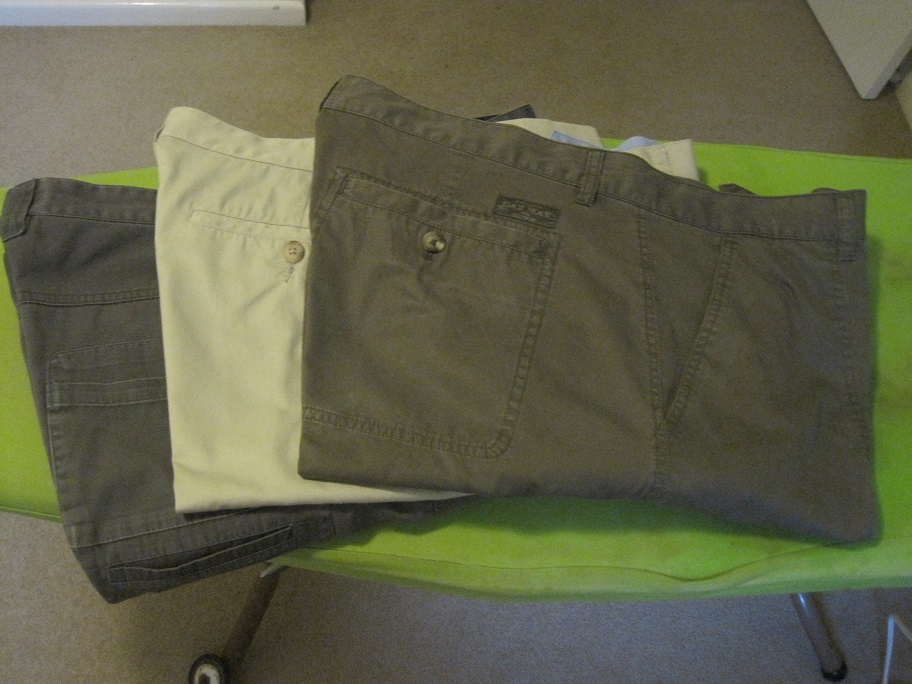
This method does not work for items such as The Duke’s shorts which are folded as part of the process of ironing them.

Shorts

Sorting the ironing and hanging the items on hangers started as a bit of a joke but it is a process that I will continue in an effort to further streamline what I do.

Clothes hangers
I know that some people always hang shirts and dresses on hangers rather than pegging them on the line to dry.  I do not generally do this, although I have 3 plastic clips that peg onto the line and you can feed the hanger through the hole.  The hangers stay in place in even the windiest weather.  I inherited these from my mother-in-law and have considered looking for more.  I checked online but cannot see the same style, however, I found this website which has an equivalent product.  It is UK-based so guess what I will be bringing home in my suitcase in September!

Project 333 – A Gent’s Perspective

4 Comments

When I first met The Duke, he owned 6 shirts – one for each day of the week plus one for going out.  His weekend tasks included washing and ironing the shirts ready for the coming week.  Since then the shirt collection has grown substantially and I wash and iron the shirts.  In fact, I managed to score the task of ironing from quite early in our relationship.

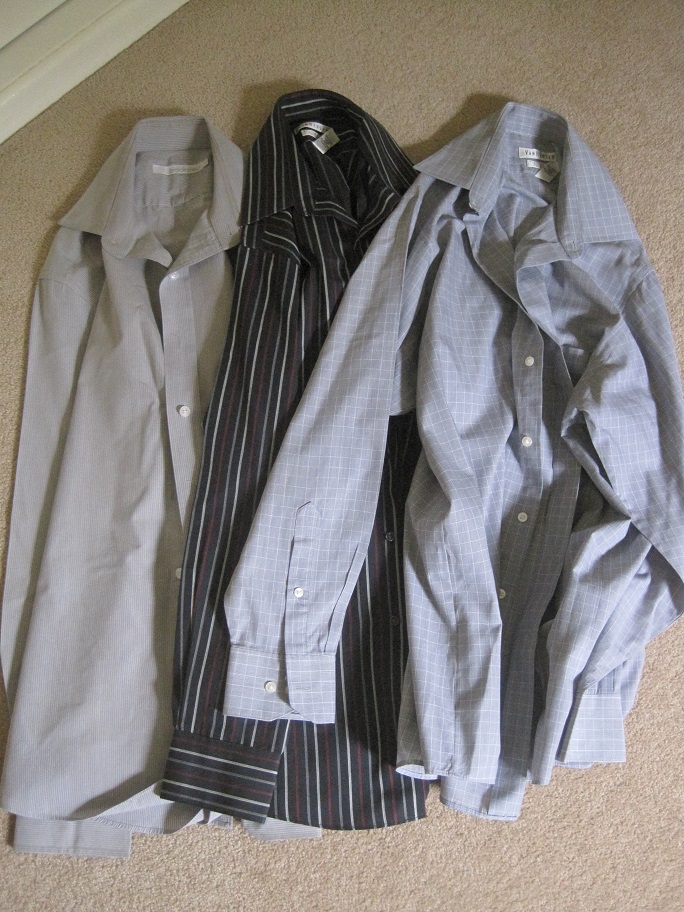
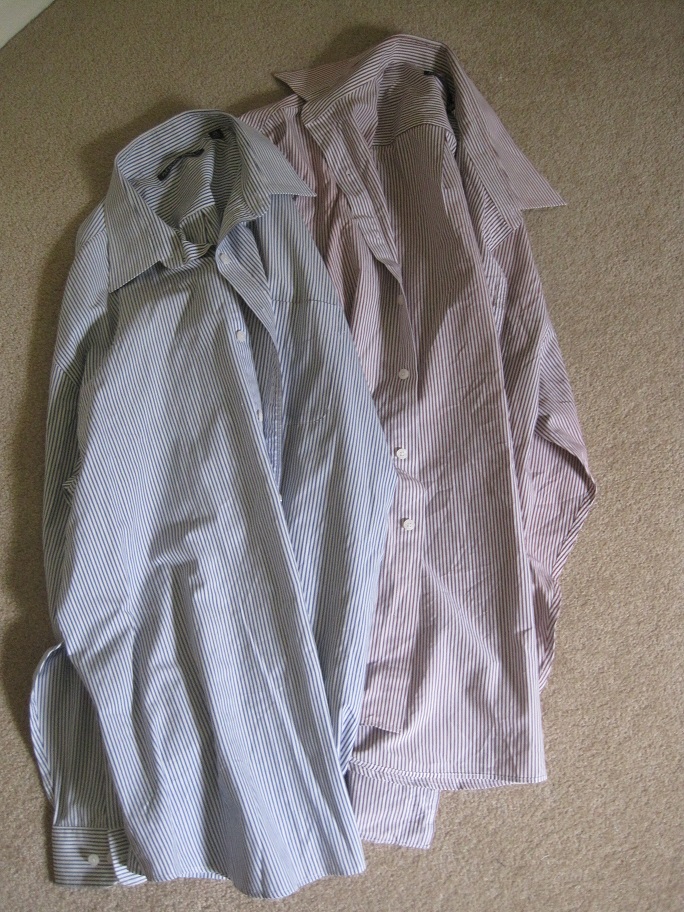
Last weekend the ironing did not get done so by the end of the second week his business shirt collection was pretty well exhausted.  Seeing the shirts that The Duke chose not to wear, even when there was almost no choice, helped to confirm that they were shirts that he was not happy with.  In the end these 3 have been earmarked for the op shop.

005
These 2 that were in the wash are also going because, to quote The Duke, “they have seen better days”.

Shirts
We are now back to just 5 business shirts plus perhaps 2 others that could do double-duty as casual /business attire.  I think 2 or 3 more business shirts might be in order, if for no other reason than to take the pressure off me having to get the ironing done every weekend.

That is one aspect of retirement that is quite appealing – not ironing business shirts.

A minimalist wardrobe certainly helps to see exactly what you wear and what stays on the hanger from season to season without being worn.

Foodie Friday – A Shopping List

2 Comments

Shopping lists are an essential ingredient if you are to have an organised approach to planning and preparing nutritious meals for your family.  They were around long before the days of personal organisers, smartphones and endless ‘to do’ lists.  My mother has always written her list on the back of a used envelope and I tend to use some sort of scrap or excess paper.

I imagine that the process of writing a list goes back to when shopping day was a major expedition, perhaps by horse and buggy, and it was vital to buy everything that was required for a month or longer.  No popping into the supermarket after work to pick up something for dinner and ending up with $50 worth of impulse buys.

Each week I buy fresh fruit and vegetables for the week plus a few basic items that I need from the supermarket. Although I write a list every week, it really comes into its own when I shop for pantry staples at Simply Good.  I try to do this about every 3 – 5 months as it is a 90km round trip.  I am not using a horse and buggy but I do have a regard for both the environmental impact of driving that distance as well as my time and energy.

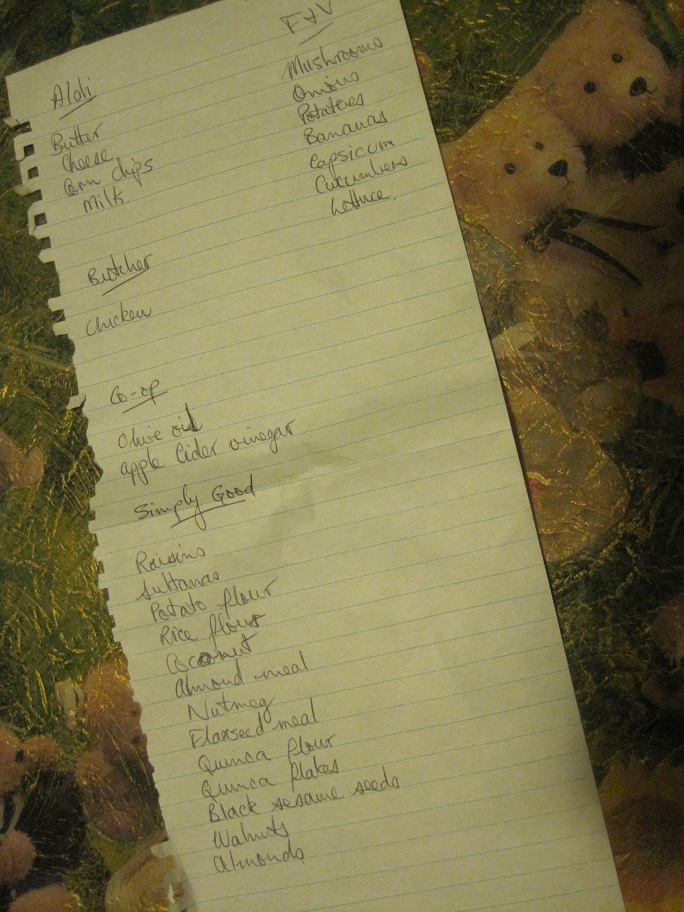
Last Saturday was a big shopping day so we set out early.  Our first stop was Simply Good, followed by Aldi, fruit and vegetable stall, the local butcher and finally the Co-op.  I checked the pantry and refrigerator before writing a comprehensive list to ensure that nothing was forgotten.  The list does vary from time to time but this will give you a broad idea of the sorts of ingredients I buy.

Shopping list
As you can see, most of what we eat is whole foods cooked from scratch so I am buying ingredients – not meals.   We eat a gluten-free diet and some of the items reflect this choice.

Next week I will show you my pantry and discuss the storage and organisation which works for me.

**Warning** – Political Opinion Ahead

Leave a comment

As I have mentioned before, this is my blog and I can basically write pretty much whatever I want.  You can choose whether or not you read it.

Tonight I want to let you know about my despair at a couple of policy decisions from our State and Federal governments.  There are many things that cause me angst but here are 2 that have come to my attention in the past day or so.

This is the text of an email is received from the Australian Conservation Foundation (ACF) today.  We have a Prime Minister who wants to revoke the UNESCO World Heritage listing of Tasmanian forests.

“We have quite enough National Parks, we have quite enough locked up forests already. In fact, in an important respect, we have too much locked up forest.
“One of the first acts of the incoming Government was to begin the process to try to get out of World Heritage listing 74,000 hectares of country in Tasmania, because [it’s] not pristine forest. It’s forest which has been logged, it’s forest which has been degraded…”
“Why should we lock up, as some kind of world heritage sanctuary, country which has been logged, degraded or planted for timber? Why should we do that?”

Do I look degraded to you?

Does this look degraded to you?
Prime Minister Abbott also said: “Man and the environment are meant for each other,” and that Greg Hunt is “an Environment Minister who appreciates that the environment is meant for man and not just the other way around.”
He supports those who “love what Mother Nature gives us and who want to husband it for the long-term best interests of humanity.”
“The last thing we should want, if we want to genuinely improve our environment, is to want to ban men and women from enjoying it… from making the most of it.”
By “making the most of it”, Prime Minister Abbott means logging the World Heritage forests, destroying the historic agreement reached by the timber industry, workers and environment groups, and ignoring the wishes of a majority of Tasmanians.
A poll published in Launceston’s Examiner on Saturday shows more than 90 per cent of Tasmanians are sick of the conflict over native forestry and support an agreement to end it.
Tasmania’s World Heritage forests are already open for enjoyment. The only way that will change is if the Prime Minister locks them up for logging.
Our petition to UNESCO to stand by their decision to protect Tassie’s forests is ACF’s fastest growing petition.

Next, is the Queensland Premier, Campbell Newman and his Energy Minister, Mark McArdle who have the solar rebate firmly in their sights.  They have announced the scrapping of the 8c/kWh feed-in tariff from July this year, leaving consumers to negotiate directly with the power companies.  This is an online news report.

Queensland Government to axe 8c-per-kWh solar feed-in tariff to cut electricity costs

THOUSANDS of southeast Queensland solar households will lose their guaranteed 8c feed-in tariff and will have to negotiate directly with retailers over a price for the energy they produce.  Energy Minister Mark McArdle will today unveil a significant overhaul of feed-in tariffs, saving other energy users millions of dollars on power bills.Mr McArdle said removing the cost of purchasing the high-priced energy produced by these solar households would put downward pressure on all electricity bills.Solar advocates have today slammed the decision to scrap the 8c feed-in tariff.Lindsay Soutar, the national director of Solar Citizens, said it would be difficult for households with solar to negotiate fair deals with retailers.“There are 40,000 homes that are about to lose the already too small financial return they receive from providing clean energy back into the grid,” she said“And there are thousands of families in Queensland who want to make the move to solar who will now be forced to negotiate directly with retailers for any sort of financial return.“This is incredibly unfair. It is obvious that it will be difficult for individual households to get a good deal from their power company.

The state government has been accused of ignoring warnings about the legal risks associated with cutting the solar power scheme.“They simply don’t have the negotiating power. When retailers set the rules, solar owners lose.”The 284,090 households that receive the 44c tariff will not be affected, with the State Government keeping its commitment to continue paying the more generous amount to those who adopted solar before the scheme was closed.The move will switch the responsibility for paying for rooftop solar power from government-owned distributors to retailers.It will affect almost 40,000 households throughout southeast Queensland that currently receive 8c per kilowatt hour for the energy produced by their rooftop solar panels.Mr McArdle last night told The Courier-Mail that the 8c tariff would have added an extra $110 million to all power bills over six years, had it continued.

Households our fourth biggest power generator

How much you’re subsidising your solar neighbour

Retailers currently get this power for free from distributors and pay solar customers up to 10c per kilowatt hour extra for their power — meaning some customers get up to 18c.“At the moment what happens is that … the feed-in tariff that is paid under the 8c is recovered by the networks and then passed through to Queenslanders in their power bills,” Mr McArdle said.“Placing it on to the retailers will mean there is no pass-through back to consumers who are not using solar.”From July 1, solar households in the Energex distribution network will not get a regulated rate for their energy and must negotiate with retailers. A new regulated rate will be set for the 10,000 solar households on the 8c feed-in tariff in the Ergon Energy area, where there is currently no competition.Mr McArdle said removing the 8c feed-in tariff in the southeast would foster competition ahead of the removal of regulated prices in July 2015.“I don’t think (retailers) will abandon solar customers, because paying the feed-in tariff is part of their market strategy to attract customers to their contracts,” he said.“Customers can then start to play retailers off against each other to get a better deal, and we may well find that the feed-in tariff increases with competition.’’

Tomorrow’s post will be a little less controversial.

Must Watch

Leave a comment

There is a relatively small amount of information and resources for Australians and it gives me great pleasure to share a link to a video which is made by Australians, about the Australian situation, using Australian statistics and information.  The video is titled ‘Waste Deep’ and was produced by the group at Sustainable Table.  The headline is “Waste Deep, a documentary that will change the way we cook and eat”.

This is not an over-the-top production designed for its shock value.  It simply and eloquently states the case for all of us to dramatically reduce our acceptance of plastic packaged, perfect food and the culture of convenience.

Please watch the video, preferably more than once.  Listen to the message and commit to acting to make a difference.  We all can make a difference.

Sustainable eating
Some of the themes are menu planning, growing your own food, reducing the amount you buy at supermarkets, supporting bulk/loose food stores, taking you own containers to be refilled, buying direct from the farmer or Farmers’ Markets and reducing before recycling.

Although this is an Australian video, the message and actions are applicable wherever you live.

What are you already doing?  What are you going to do?  Please share your thoughts and ideas so that we can build an online network to follow these principles and make a difference.

Shrove Tuesday

2 Comments

Today is Shrove Tuesday, also known as Pancake Day.  It is the day before Ash Wednesday which marks the beginning of penitential season of Lent.  Pancakes were traditionally eaten to use up the rich foods such as milk, eggs and sugar.  You can read more about the origins here.

Despite eating a gluten-free diet I still managed to have pancakes for dessert.

Buckwheat pancakes
I made a half quantity of the following recipe which made 4 nicely sized pancakes/pikelets.  We drizzled a little lemon juice on them and topped with a sprinkle of sugar.  Yum!!

BUCKWHEAT PANCAKES – The recipe is my adaptation of one from The Healthy Chef – check it out here.

160 g  milk ( rice, almond, dairy, seed)
50 g buckwheat flour
50 g ground almond meal
20 g ground flax seed (linseed)
Half teaspoon bicarb soda (baking soda)
1 teaspoon apple cider vinegar

Combine the milk, buckwheat flour, almond meal, flax seed, baking soda and vinegar to form a smooth batter.

Heat a non stick pan with a little organic cold pressed coconut oil or macadamia nut oil and drop in about 2 tablespoons of batter for each pancake.  Turn the pancake over gently the cook for a further 2 minutes until the pancake is golden brown and cooked through.


Gently Grey

2 Comments

Many of the things I do and decisions I make have their origins in the desire to live a simpler, more streamlined existence.  However, in time it becomes part of who I am and I tend to forget about what prompted my decision in the first place.

I was reading Fifty, Not Frumpy the other day and as well as the gorgeously styled outfits I was struck by the colour of Susan’s hair.  Mine is not and possibly will never be that colour but it reminded me of my own choices that I have made.

Like many young women, I began to notice a small amount of grey in my hair at around my 30th birthday.  I have never been a big spender on expensive hair styling and salon treatments so I coloured it myself for about 15 years.  During that time I had a couple of attempts at leaving my hair as its natural colour but was not overly impressed with the result.  There was not enough grey to be significant and the effect was dull and ‘bleugh’.

I finally bit the bullet when I was in my mid forties.  I did not have too much of an issue growing it out as I tend to keep my hair cut fairly short anyway.

Going grey
While my hair is far from completely grey, it is obvious that it is natural and not coloured.  It is easy to maintain and fits nicely with my simple life.

I have my hair cut about every 6 – 7 weeks which costs me $35 at a city salon.  I buy shampoo and conditioner from the Co-op.  They are in bulk containers and I can refill my bottles plus it contains no sodium laureth sulfate or other nasty chemicals.  A splash of water and a hairbrush are the only styling aids I use.  You can’t get much more simple than that.


Busy with Bags

1 Comment

This afternoon I re-acquainted myself with my sewing machine.  I have several projects that I want to get done but I decided to start with something manageable that I could finish in an afternoon.

First, I mended this reuseable silk bag which I was given about 10 years ago.  It is used frequently and some of the stitching at the top of the side seams had come undone.

Ecosilk bag

Next, I retrieved a piece of material I bought some years ago for the purpose of making another bag using this one as a pattern.  Sometimes my grand plans turn out to be more complex than I imagine but it was not the case this time.

New bag

I successfully replicated the original, complete with side gussets and double stitched seams on the handles and bottom edge of the bag.

The best part about these bags is that they are lightweight and fold down to almost nothing.  I was spurred into action as I wanted to have 2 lightweight bags to take when we travel overseas.  They can be used for grocery shopping, carrying personal effects to a shared bathroom or keeping worn clothes separate from clean ones when packing.  They can be easily washed and will dry in a matter of hours.  The total weight of the 2 bags is 79g.

Folded bag
Finally,  I made a lining for a hessian carry bag that I bought when we were in the USA in 2012.  The bag originally had a plastic coating on the inside but it was starting to crack and deteriorate as you can see here.

Inside of hessian bag
I removed all of the plastic coating and then washed the bag as it was quite grubby from use every week.  I measured the dimensions of the bag and then cut out and made a lining from some navy poly cotton fabric.  It matches nicely with the print on the outside of the bag.

Stitching new lining
Here is the new lining assembled and pinned in place.  Tonight I will sit and handstitch the lining to the top edge of the bag.  I will add a photo of it when I am finished.

It has been a successful afternoon of some small sewing tasks.  Do you make or repair items that you use?  Do you use reuseable shopping bags?