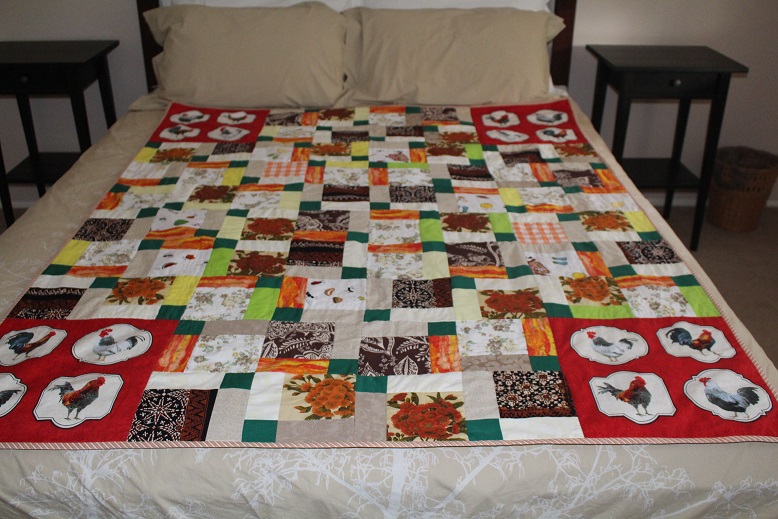
I have been occupied with a couple of projects that are not blogworthy, or in one case, unable to be posted about as it is a gift I am making.
Meanwhile, here is a copy of a piece which I read today. It is written by The Gherkin, a cartoon pickle who inhabits various online platforms, including Facebook and Substack.

I am adding this to the blog as links can break and I want to retain this for my own reference as well as sharing it. A worthy and thoughtful piece of writing. The writing below is unedited apart from the removal of the images in the original.
For my international readers, Pauline Hanson is the leader of a right-wing political party in Australia.
The Monoculture That Never Existed
Pauline Hanson wants Australia to return to a monoculture.
The first difficulty is identifying when Australia ever had one.
Was it before European settlement, when hundreds of First Nations maintained distinct languages, laws, customs, spiritual traditions and systems of knowledge across the continent?
Presumably not. That Australia is rarely the one people mean when demanding a return to cultural unity.
Was it colonial Australia, divided between British and Irish, Protestant and Catholic, free settlers and convicts, cities and bush, wealthy landowners and workers, people loyal to the Empire and people who considered the Empire an occupying landlord with good tailoring?
Not especially mono.
Was it the gold-rush era, when Chinese migrants, Europeans, Americans and people from across the world arrived and transformed the colonies?
Apparently not.
Was it the post-war Australia reshaped by Italians, Greeks, Maltese, Dutch, Germans, Poles, Yugoslavs and others, followed later by Vietnamese, Lebanese, Chinese, Indian, Filipino, African and Middle Eastern communities?
That seems unlikely too, although this is usually the point where the fantasy begins editing the family album.
Perhaps the monoculture existed for eleven minutes in 1957, somewhere between a meat raffle and the final vegetable being boiled beyond recognition.
Nobody took a photograph.
The truth is that Australia has never been culturally uniform.
It has had dominant institutions. Dominant traditions. Dominant religions. Dominant accents. Dominant stories about itself.
It has had periods when some cultures were treated as properly Australian and others were expected to remain quiet, grateful and preferably useful.
But dominance is not the same as unity.
Silence is not the same as cohesion.
And a hierarchy of cultures is not a monoculture simply because the people at the top stopped noticing everyone underneath them.
What Hanson now says she means
Hanson has attempted to clarify her position.
She says Australia can be multiracial while remaining monocultural. Migrants may apparently keep some food, customs and family traditions, provided they accept a common Australian identity, shared laws and national values.
She has cited democracy, freedom and the rule of law. She has insisted she is not objecting to foreign cuisine or demanding that every migrant abandon every trace of where they came from.
She has also invoked Paul Hogan and Norman Gunston as examples of the Australian monoculture, which suggests the governing civilisation may consist largely of irreverent blokes from vintage television.
It is a relief to know the cultural constitution survived in an archive at the ABC.
The clarification sounds more reasonable than the original declaration because much of it describes something Australia already has.
One legal system.
One democratic framework.
Common citizenship.
Broad civic expectations.
A national language used across government, education and public institutions.
Shared obligations to obey the law, respect the rights of others and participate peacefully in democratic life.
None of this requires monoculture.
It requires a civic culture.
That distinction is not cosmetic.
A civic culture establishes the rules under which different people live together. A monoculture attempts to establish which cultural expression should be treated as normal, central and authentically national.
The former gives a plural society common ground.
The latter gives one group the right to describe its own habits as the country itself.
Hanson’s argument repeatedly slides between the two.
When challenged, “monoculture” becomes nothing more threatening than shared law and democratic values.
When she returns to the political stage, it expands again to encompass language spoken inside homes, religious clothing, the visibility of minority traditions, multicultural institutions and the vague sense that Australia no longer feels sufficiently familiar to some Australians.
The word contracts under scrutiny and expands before an audience.
That is why it is politically useful.
It can sound like civic unity to moderates and cultural restoration to people who want minorities placed back behind the scenery.
Australia already has shared values
There is a legitimate argument buried somewhere beneath the rubble.
A successful country does need shared civic commitments.
Citizens must accept democratic government, the rule of law, equal citizenship, peaceful political participation, freedom of belief, freedom from coercion and the basic rights of others.
No culture should excuse violence, forced marriage, child abuse, religious extremism, racial hatred or the subordination of people under a parallel system of coercive authority.
Australian law prevails.
That should not be controversial.
Multiculturalism has never meant giving every cultural practice equal legal authority or treating all behaviour as acceptable because someone’s grandfather once did it elsewhere.
A plural society requires boundaries.
It also requires confidence in enforcing them.
There are serious discussions to be had about integration, linguistic access, social isolation, extremist ideologies, gender equality, civic education and whether settlement systems help new arrivals understand their rights and obligations.
But none of that establishes the need for monoculture.
It establishes the need for good government.
The law does not require a family to stop speaking Greek at dinner.
Democracy does not collapse because someone wears a turban.
Freedom is not weakened by a child growing up with two languages.
The rule of law does not depend on whether a suburb contains more dumpling restaurants than country pubs.
A nation can share institutions without sharing identical customs.
It can possess a common civic framework while containing enormous variety in food, faith, music, humour, family life, art, language and memory.
Australia has already demonstrated this for generations.
Not perfectly. Not without tension. Not without discrimination, exclusion and occasional bursts of national stupidity.
But successfully enough that people from nearly every country on Earth now live here under the same democratic system.
That is not evidence that multiculturalism has failed.
It is evidence that pluralism and civic unity are capable of occupying the same postcode.
The culture Hanson remembers was already borrowed
The monoculture fantasy depends upon treating some imported cultures as Australian and others as foreign.
British institutions are Australian.
Irish rebellion is Australian.
Christian traditions are Australian.
Fish and chips are Australian.
The pub is Australian.
Cricket is Australian.
Parliamentary democracy is Australian.
Common law is Australian.
The King is Australian enough to justify a public holiday.
All of these things came from elsewhere.
They became Australian because time passed, power settled around them and people stopped describing them as imports.
This is one of the great tricks of cultural dominance.
Its own migration story becomes invisible.
The British did not emerge naturally from the soil somewhere outside Bathurst. They arrived with foreign laws, foreign institutions, foreign religions, foreign clothing, foreign animals, foreign crops and a fairly robust sense that everybody already here should adjust.
Yet their inheritance is described as foundational culture, while later arrivals are asked whether they have assimilated sufficiently into it.
The distinction is not between foreign and Australian.
It is between old foreignness and new foreignness.
The Italian café became Australian once enough decades passed and enough politicians learned to order espresso.
Greek food became part of the suburban landscape.
Garlic survived its early reputation as an exotic threat.
The kebab became emergency national infrastructure sometime after midnight.
Vietnamese bakeries improved the Australian lunch beyond measure.
Asian grocery stores supplied ingredients people now regard as indispensable.
Lebanese, Indian, Chinese, Turkish and African communities reshaped cities, businesses, sport, medicine, education and family life.
The country absorbed all of it.
Then, after digestion, it called the result Australian.
What Hanson calls a monoculture is often multiculturalism after the labels have fallen off.
Assimilation is always demanded from the newest arrival
Every migrant wave has been told it might not fit.
The Irish were considered disloyal, disorderly and religiously suspect.
Chinese migrants were treated as an existential threat.
Southern Europeans were described as culturally incompatible.
Jewish refugees were regarded with suspicion.
Vietnamese refugees were accused of changing suburbs and failing to assimilate.
Lebanese Australians became recurring targets of national panic.
Muslim communities inherited the position of permanent cultural defendant.
African-Australian young people were transformed into crime statistics before many had finished school.
The language changes slightly.
The structure does not.
“They do not share our values”, “They form enclaves”, “They speak their own language”, “They have too many children”, “They do not respect women”, “They bring crime”, “They are changing the character of the country”, “Their loyalty is to their home country”.
Then time passes.
Children grow up.
Communities disperse.
Businesses open.
Intermarriage happens.
Accents soften or multiply.
The food enters the national bloodstream.
A footballer scores.
A doctor saves a life.
A neighbour becomes simply a neighbour.
Yesterday’s incompatible foreigner becomes today’s evidence that assimilation used to work properly.
And a new group is placed under examination.
Australia’s assimilation story is not a straight line toward cultural sameness.
It is a revolving door through which every established migrant community eventually gains permission to worry about the people coming after it.
The invention of a single Australian character
The monoculture argument also relies on the fiction that Australians once shared a single character.
Which Australians?
The affluent Protestant establishment of Melbourne?
Catholic workers in Sydney?
Queensland cane cutters?
Aboriginal stockmen?
Unionists in mining towns?
Greek shopkeepers?
Italian market gardeners?
Vietnamese families in Cabramatta?
Pastoral families in the interior?
Queer people surviving quietly in hostile suburbs?
Women denied equal opportunity while being told the nation’s culture was egalitarian?
Australia has always contained competing moral traditions.
Individualism and collectivism.
Deference and irreverence.
Militarism and anti-authoritarianism.
Religious conservatism and secular indifference.
City cosmopolitanism and rural localism.
Union solidarity and business ambition.
A mythology of mateship alongside a long history of exclusion from the category of mate.
Even our most beloved national traits are contradictory.
We claim to distrust authority and then demand harsher policing.
We celebrate the underdog and worship property prices.
We insist everyone deserves a fair go, then conduct regular public debates about who counts as everyone.
We mock pretension while maintaining private schools with rowing sheds more elaborate than regional hospitals.
Australian culture is not a clean doctrine.
It is a long, noisy argument with excellent catering.
That is why attempts to define one authoritative national culture always end in vague language.
Mateship. Fairness. Humour. Freedom. A go.
These are admirable concepts.
They are also interpreted differently by different Australians.
The egalitarian believes fairness means strong public services.
The libertarian believes it means less government.
The conservative finds freedom in stable institutions.
The activist finds freedom in changing them.
The worker hears “fair go” and thinks wages.
The property investor hears it and thinks negative gearing.
The phrase survives because its ambiguity allows everyone to salute it while imagining something different.
That is culture.
Messy, contested and alive.
Not mono.
The First Nations problem for monocultural nostalgia
Any serious claim that Australia possesses one authentic culture encounters an obvious historical obstacle.
First Nations cultures.
Australia did not begin as a monoculture.
It contained hundreds of Aboriginal and Torres Strait Islander nations, languages, legal orders and cultural traditions before British colonisation.
Diversity is not a recent policy imported by bureaucrats with lanyards.
It is older than the Commonwealth.
Older than the Constitution.
Older than the flag.
Older than the English language on this continent.
This creates an uncomfortable problem for politicians who want to describe Anglo-Celtic inheritance as the natural cultural foundation of Australia while condemning multiculturalism as an artificial disruption.
The dominant culture they wish to restore was itself imposed upon a pre-existing plurality.
The monocultural project was not an innocent historical condition.
It was produced through colonisation, dispossession, assimilation policy, restrictions on language and the attempt to erase Indigenous identity.
That does not mean contemporary Australians inherited personal guilt for every historical act.
It means we should be careful before romanticising cultural uniformity as though it emerged peacefully from a shared barbecue recipe.
Australia’s strongest moments have often come from abandoning enforced sameness.
Ending the White Australia policy.
Accepting refugees.
Recognising Indigenous rights.
Removing legal discrimination.
Allowing people to retain cultural identity while participating fully in public life.
These changes did not destroy Australia.
They forced Australia to become more honest about who belonged to it.
Cohesion is not sameness
The central error is confusing cohesion with sameness.
A football team is cohesive without every player being identical.
A family can be cohesive despite disagreement.
A city can be cohesive without everyone attending the same church, eating the same food or voting for the same party.
What holds a plural society together is not the elimination of difference.
It is a set of trusted institutions, fair laws, shared public spaces, economic opportunity and the belief that membership is genuine.
People integrate more successfully when they can participate.
When they can find work.
When their children attend good schools.
When housing is available.
When public services function.
When discrimination does not trap them outside institutions.
When the national identity has room for them without demanding a ritual humiliation first.
Social cohesion weakens when communities become isolated, when opportunity disappears, when governments fail to plan, when housing shortages intensify competition and when politicians deliberately attach every public failure to an ethnic target.
If Hanson is genuinely concerned about cohesion, she might consider the effect of spending thirty years telling parts of the population they are culturally suspect.
Nothing builds unity like a permanent public audition for belonging.
The people demanding assimilation often reject the outcome
There is another contradiction.
When migrants participate fully, succeed and represent Australia, they are frequently praised as examples of proper assimilation.
The Socceroos win and suddenly multicultural Australia is allowed on the podium.
A refugee becomes a doctor, athlete or entrepreneur and their story is claimed as proof of Australian opportunity.
Fine.
Australia should be proud of these stories.
But belonging cannot depend upon exceptional performance.
A migrant should not need to score at a World Cup, cure cancer, build a company or rescue someone from the surf to earn release from cultural suspicion.
Ordinary belonging counts too.
The factory worker.
The taxi driver.
The parent.
The student.
The exhausted nurse.
The family running a suburban takeaway.
The child who grows up here, complains about politicians, avoids public transport replacement buses and develops a completely Australian inability to discuss house prices calmly.
They do not owe the country a heroic repayment.
Citizenship is not a talent show.
The deeper problem is that even successful assimilation rarely satisfies the cultural gatekeepers.
Migrants are told to become Australian.
Then, when they do, multiculturalism is denied credit because they have supposedly stopped being migrants.
Their contribution is absorbed into the national identity while their origins are erased from the accounting.
Australia receives all the benefits.
Multiculturalism is declared unnecessary.
A remarkably tidy arrangement.
Why the fantasy persists
The monoculture persists because it offers emotional simplicity.
The modern country is complicated.
Cities change quickly.
Neighbourhoods transform.
Institutions become less familiar.
Economic insecurity makes cultural change feel threatening.
People hear languages they do not understand, encounter customs they do not recognise and wonder whether the country is moving without them.
Those feelings should not simply be mocked.
Belonging matters to everyone.
People want continuity.
They want to recognise their home.
They want assurance that change has limits and that the national story still includes them.
Mainstream politics often responds badly, either with empty celebration or moral accusation.
But Hanson does not resolve that anxiety.
She monetises it.
She tells people their discomfort proves the country has been stolen.
She gives the unfamiliar a culprit.
She describes pluralism as surrender and visibility as domination.
Then she offers restoration to a past that never existed.
That is the seductive power of monocultural nostalgia.
No implementation is required because the policy exists mostly in memory.
And memory is wonderfully cooperative when nobody checks the records.
A better national confidence
Australia does need a confident national identity.
But confidence does not mean fragility dressed as strength.
A confident country can hear different languages without panicking.
It can maintain common law without demanding common cuisine.
It can celebrate its British inheritance without pretending history began there.
It can recognise First Nations cultures without treating national unity as a casualty.
It can welcome migrants while managing numbers sustainably.
It can confront extremism without condemning entire communities.
It can ask newcomers to participate while making participation genuinely possible.
It can preserve traditions without freezing the country in one generation’s childhood.
Culture is not a museum exhibit.
It changes because people live inside it.
The Australian culture Hanson claims to defend was itself shaped by waves of people who altered what came before.
That process did not leave us culturally empty.
It gave us what we now recognise as Australian.
The irony is that the monoculture she wants to protect is largely the product of earlier multiculturalism.
She is defending yesterday’s diversity against today’s.
The final myth
The Australian monoculture never existed.
What existed was a hierarchy in which some cultures were called Australian and everyone else was expected to become quieter.
What existed was a dominant story that edited out its own foreign origins.
What existed was diversity without equal recognition.
And what exists now is a country still learning how to describe itself honestly.
Australia is not culturally pure.
Thank God.
It is layered, contradictory, borrowed, improvised and continuously remade.
Its institutions came from elsewhere.
Its food came from everywhere.
Its language carries words from Indigenous Australia, Britain, America and generations of migrants.
Its cities are archives of arrival.
Its families contain histories that cross oceans.
Its national character consists partly of denying all this while eating souvlaki and watching a refugee’s child score for the Socceroos.
Pauline Hanson does not want a culture shared confidently by everyone.
She wants one culture treated as the landlord and the others reminded they are tenants.
That is not unity.
It is nostalgia with a dress code.
The challenge for Australia is not to recover a monoculture that never existed.
It is to build a common future among the people who actually live here.
Different histories.
Equal citizenship.
One law.
Many stories.
And enough national confidence to cope with all of them.
Australia has never been culturally simple, no matter how often politics tries to flatten it into a postcard from someone else’s childhood.
We have always been layered. Indigenous, British, Irish, Chinese, European, Asian, African, Middle Eastern, Pacific, and everything formed in the spaces between. The argument has never really been about whether Australia has one culture. It has been about whose culture gets treated as the default, and whose is expected to remain politely in the background.
That is why this conversation matters.
A confident country does not need everyone to be the same. It needs common laws, equal citizenship, functioning institutions, and enough self-belief to live with the fact that the national story is bigger than any one group’s memory of it.
_________________________________________________________________________________________________________
I do not often post political material and I believe any discussion regarding multiculturalism in Australia needs to be thoughtful and respectful so please consider this in any comments.
Rude or unhelpful comments will not be published.
Thank you.