A New Neckline

Leave a comment

I bought this top a few years ago and have only worn it a handful of times.  In fact, I did not even wear it last winter.  When I rearranged my wardrobe recently I decided to make sure that every piece earned its place.

2020-06-05 01

I put the top on briefly the other day and realised why I don’t choose to wear it.  I do not like the feel of high, fitted necklines and this was simply not comfortable.

I had nothing to lose so I set about modifying the neckline.  I cut just below the ribbed band.  The pins mark the quarter points of the new neckline.

2020-06-05 02

New ribbing pinned in place.

2020-06-05 03

The finished article with a new, more comfortable neckline.  It will look better once the seam is pressed.  I am looking forward to getting plenty of wear out of the top in the coming months.

2020-06-05 04

Approximately 15minutes of my time was all that was needed to turn this into a garment that I will be happy to wear.

Cold Frame Construction

3 Comments

What is a cold frame?  The best description is a mini glasshouse which is low to the ground.  You can check out one from Gardening Australia here.  They are predominately used in much colder climates than ours, however, the primary reason that we built one is that I want to grow basil throughout the winter months.  It will also be perfect for starting spring seedlings a bit earlier than usual.

For the past few weeks we have been taking small steps towards building a cold frame.

Two hardwood sleepers form the back wall.

2020-06-04 01

Deciding on a location, sourcing materials (the majority secondhand) and developing a design have all taken time.  GMan has cut and painted timber as well as replacing putty in the window frames.

Everything has moved up a notch in the last couple of days as we began building in earnest.

The construction is almost complete with only the polycarbonate sheeting to be added to the front and ends of the enclosure.  This last step is on hold until we retrieve our jigsaw (lent out recently) to cut the sheeting.  Hopefully this will happen early next week.

2020-06-04 02

We won’t win any prizes for our carpentry skills but the structure is solid and functional.

2020-06-04 03

A pair of casement windows from the timber salvage yard form the top of the cold frame.  They are hinged at the back and we attached some old cupboard handles to the front edge to facilitate easy access.

2020-06-04 04

Apart from the polycarbonate sheeting on the sides, we also need to finish levelling the ground and filling the holes around the uprights.

In the meantime I have put the tray of basil seedlings in this space overnight as even without the sides completed it still offers a warmer and more protected space than their previous location.

The components which we purchased new for this project were the sleepers, hinges, window putty and long screws for the frame.  The windows, handles and timber all came from the salvage yard while the screw used with the hinges and handles came from our collection of odds and ends at home.

I would love to hear of anyone else’s experience  with a similar kind of set-up.

A Bit of Wire

Leave a comment

I am a great fan of wire.  It is so useful.  My mother reckons that I have inherited my love of wire from my grandfather who, reputedly, could fix anything with a bit of wire.  As a farmer, a lot of his skill would simply have been tied to the fact that ‘necessity is the mother of invention’.

Although I grew up in the city, I now live on a semi-rural small acreage and those same skills are required from time to time.  Apart from genetics, at least some of my ability to use wire was honed during my career working in operating theatres.  The principles of application of wire remain the same, regardless of whether it is a fractured ankle, a fractured jaw or attaching fencing wire to a post.

Here are a couple of recent examples of my handiwork.

Attaching the weldmesh panels to star pickets for the sides of the compost bays.

2020-05-31 01

We bought a decorative wind ornament for the garden a few months ago but the pole was not sturdy enough to maintain an upright position.

2020-05-31 02

So, we placed a star picket immediately beside the pole and wired it to the star picket in 3 places to provide a sturdy brace.

2020-05-31 03

A couple of things to keep in mind when using wire.

Consider where the ‘knot’ will finish and make sure that it can be tucked out of the way to avoid risk of injury.

Make sure that the item is strong enough to accept to force of tensioning the wire.

Use a suitable gauge of wire appropriate to the job.

Always hold the end of the wire when cutting it to avoid injury.


Last of the Autumn Salad

Leave a comment

You have heard of ‘Last of the Summer Wine’?  Well, this is a little different.

Our meal this evening was Zucchini and Corn Fritters.  You can find the recipe here.

2020-05-30 01

The accompanying salad was sourced entirely from our garden.  Lettuce, cherry tomatoes and coriander were picked today while the cucumber is the end of the last one which we picked about 3 weeks ago.

We found that cucumber stored really well in the crisper section of the refrigerator.  The lettuce is going to seed but in our mild climate there is a good chance that we will even have some more self-sown ones during the winter months.  There are still fruit on the various cherry tomato plants scattered throughout the garden.  We do not experience frosts here so it is likely that we will continue to harvest a few here and there but it will not abundance we have had during the summer and autumn.  Coriander has self-seeded throughout our garden area and we are thrilled as the flower heads are particularly loved by the bees.

I made the sweet chilli sauce from chillies from my sister’s garden.  The details and recipe are in an earlier post.

Seasonal eating means that we value and appreciate the produce from our garden.  It is probably about 5 months until I next eat cucumber and I know that by then I will be really looking forward to that first crisp crunch.

Money For Jam

2 Comments

We have all heard of the phrase, ‘money for jam’, this post is about jam for very little money.  Making your own jam is probably one of the best ways to save money.  Commercially prepared jams often contain very little in the way of fruit and ‘premium’ brands are ridiculously expensive.

In the blog post from yesterday I shared how I had sliced and soaked the homegrown grapefruit.

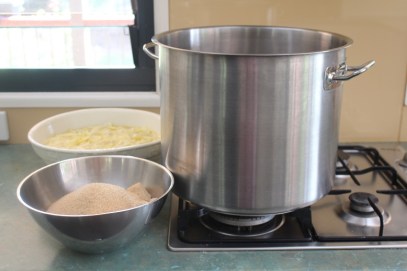
After being soaked for about 15 hours I was ready to make the marmalade.
2020-05-29 01

Like most jam recipes this one is very simple.  The original from Annabel Langbein is here.  I chose not to use the whiskey.

You will need equal quantities of fruit and sugar and an equivalent volume of water.

For example, I used:

1.2kg of grapefruit Scrubbed, quartered and thinly sliced
1.2 litres water
1.2kg sugar

Cut the unpeeled grapefruit into quarters, then slice finely by hand or using the slicing attachment of a food processor. Place in a wide, non-corrosive preserving pan and cover with 1.2 litres of water. Cover and leave to soak overnight.

The next day, place the pot over a high heat, bring to the boil and boil for 40 minutes. Lower the heat and add the sugar. Stir until the sugar is dissolved, then return to the boil and boil for an hour, stirring every 10 minutes or so to prevent the grapefruit from catching on the bottom – you want it to almost catch, but not burn. If you feel it starting to catch, remove it from the heat for a couple of minutes, giving it a gentle stir to stop it burning on the bottom, then continue boiling.

After 55 minutes do a ‘set test’ to check if your marmalade is ready. Chill a saucer in the fridge for a few minutes, then drop a teaspoonful of marmalade onto it. The marmalade is ready when it forms a skin that wrinkles when you hold the plate on an angle. At this point add the whiskey and boil for couple of minutes more to burn off the alcohol.

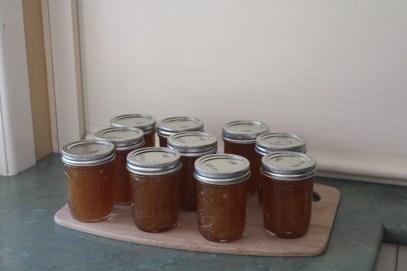
Pour straight into sterilised jars and seal with sterilised lids. If properly sealed Grapefruit Marmalade will last indefinitely.

To prepare your jars for preserving: For this recipe you will need a selection of jars that will hold just over 4 litres of marmalade. This is a great way of recycling, as the jars and their metal lids can be used over and over again. Wash the jars as usual, then remove the lids and place the lids and jars in the sink. Cover them well with boiling water then drain off the water. Pre-heat the oven to 100°C then pop the jars and lids in for 15 minutes to sterilise. Once removed from the oven, put the lids on the jars immediately so they remain sterile until you are ready to fill them.

The end result of 1.2kg of homegrown fruit, 1.2kg of sugar and about 1.5 hours of my time and we have about 2.5kg of jam added to our stock cupboard.
2020-05-29 02

Garden Edge and Grapefruit

1 Comment

While there are plenty of photos of our vegetable garden there is much less evidence of the rest of the garden.  Some of it is quite naturalised and, in parts, overgrown.  We want to keep it as natural as possible but some areas require clearance of invasive weeds which are a real pest as they thrive in our high rainfall,  sub-tropical climate.  Little by little, we are planting native shrubs, in many cases, indigenous to the local area.

2020-05-28 01

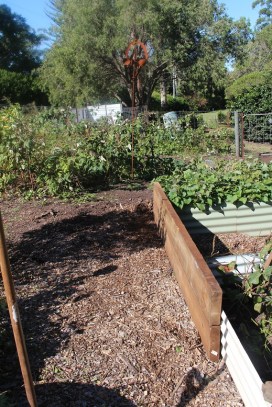
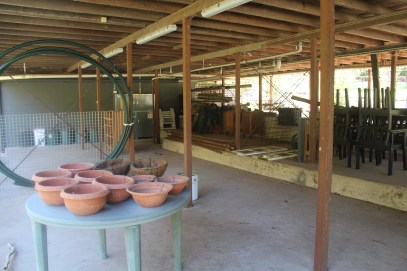
This area alongside our western boundary fence had long been neglected.  As part of the preparation for the soon to be assembled garden shed we cleared the area and have planted 3 new shrubs.  In order to be able to maintain the area we have placed a rock edge about 1.5 metres from the fence.  The rocks were all sourced from our property.  Rocks are an abundant resource here and we use them for a multitude of purposes.
2020-05-28 02

As I mentioned in this post we have an orchard of about 10 citrus trees and were unfortunate enough to have an infestation of citrus fruit piercing moth a couple of months ago.  Whether it is their lifecycle, the cold weather or simply a natural progression, they appear to have moved on and I think the Valencia oranges may have been spared as well as some of the grapefruit and the netted mandarin.

2020-05-28 03

Today I picked several grapefruit – enough to make a batch of marmalade.  I sliced and soaked the fruit and will be making the marmalade tomorrow so will post all of the details then.

I started to cut them by hand.

2020-05-28 04

However, that proved too difficult so I heeded the advice of the recipe and used the thin slicing blade of my food processor which made short work of the job.  It was a simple matter of retrieving the ends of the quarters and slcing the last bits by hand.

2020-05-28 05

Soaking overnight.

2020-05-28 06


Patched Pants

2 Comments

Some would say that these shorts are not worth mending.  They are at least 25 years old and once upon a time they were 3/4 length travel pants.  After much wearing the knees finally gave way and I cut them off into a fairly unflattering pair of shorts.  They were only ever destined to be worn around the yard but they get a good workout fulfilling that role.  An incredibly comfortable pair of shorts that are lightweight and perfect for our hot summers.

They have been patched several times but the most recent rips almost saw the end of them.

2020-05-27 01

I decided to make an attempt on one more patch.

I selected a piece of strong cotton fabric which would generously cover the two large rips.  I then cut a matching piece of double-sided iron-on interfacing and ironed it to the wrong side of the patch.


Remove the paper backing and place on the wrong side of the area to be patched.  Make sure that the rips are closely aligned then press again to fuse the patch to the garment.

Use a wide zigzag stitch to stitch over the rip.  You may need to do several runs to cover it.  Finally, use a narrower zigzag stitch to finish the edges of the patch.

The outside and inside views when completed.

This is not invisible or even particularly neat so is really only suitable for clothes where looks are not important.

We spend a significant amount of time in the garden or painting and renovating so functional ‘old’ clothes are a must.  It makes sense to extend the life of them as much as possible.

My shorts with multiple patches have survived to see another summer but that is a few months away yet.  It is good to be prepared, though.

2020-05-27 08


More Than Washing

1 Comment

What does doing the washing mean to you?  Grabbing an armful of used clothes and tossing them into the washing machine and then transferring them to the dryer?  Or do you have a careful sorting and separating process?

I sort my washing into light and dark fabrics, check the pockets for errant coins, tissues or slips of paper and then turn the articles so that they are the right side out.  They are then washed and hung on the clothesline under the verandah.  When the clothes are dry I sort them into the items that need to be ironed and those that can be folded and put away immediately.

All of this process allows plenty of opportunity to examine items for any damage or wear and tear which requires repair.  The old adage, ‘a stitch in time saves nine’ is very true.

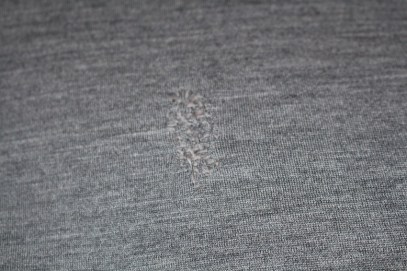
This week I found a small hole and run in the front of one of GMan’s merino thermal tops.

2020-05-26 01

My darning skills are somewhat limited but I do have a rudimentary understanding of what is required.  Since this is an undergarment, a perfect result is not essential.   I found some similar coloured tapestry wool and split it to extract a single strand to use.

The end result is functional if not particularly pretty.

2020-05-26 02

Regardless of the type of garment, it is worth checking clothes regularly to ensure that they are maintained which will prolong the life of the garment.  Things to look for include loose buttons, hems coming down, breakage of side seams near pockets or armholes.

Leftover Lasagne

1 Comment

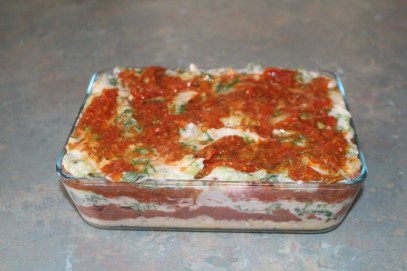
Not lasagne that is leftover.  It is lasagne made from leftovers.

This post is not so much a recipe but a demonstration of what can be done to minimise food wastage.  A germ of an idea that grew……………….into dinner.

I make my own refried beans and for some reason 2 different containers were opened and in the refrigerator.  I decided that they needed to be used up.

From the freezer I sourced a small container of cooked brown rice and a bag of cherry tomatoes.  The tomatoes are from our garden – at least a year ago.

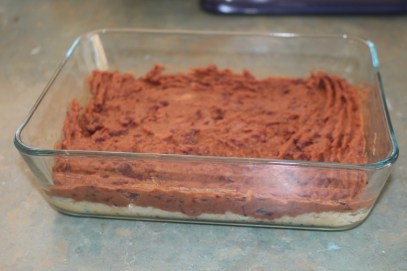
Once the rice was thawed, I heated it then added a beaten egg and pressed the mixture into the bottom of the dish.  Next was a layer of refried beans.

2020-05-25 01

Next, I headed to the garden to harvest one of the giant bok choy.  The stalks and leaves were chopped separately.  I wilted the shredded leaves in a pan and cooked the finely sliced stalks until tender.

Meanwhile, I made some white sauce.  I use potato starch and besan flour to thicken the mixture so that it is gluten free.  I then mixed in the bok choy.

The tomatoes were simmered and reduced, herbs and seasonings added.

2020-05-25 06

Then it was time to assemble the remainder.

Half of the bok choy/white sauce mixture then half of the tomato mixture.

Repeat with refried beans, bok choy and tomatoes.

2020-05-25 07

The final step will be to sprinkle with crumbs and grated cheese and bake until heated through.  I use flaxseed meal instead of breadcrumbs for a nutritious and gluten-free alternative.

This will make 4 generous adult serves so we will have half of it for dinner and the remainder for another meal.


Construction Progress

Leave a comment

Today I thought I would share some of the progress on a couple of construction projects.  After some time in the design and preparation phase, the cold frame is beginning to take shape.

We bought the 2 hardwood sleepers to create the back wall of the cold frame.

2020-05-24 01

They are now in position.

2020-05-24 02

The compost tumbler which can be seen in the background was quite close to where we were working so it has been moved.  GMan is yet to decide on a final location for it.

The area under the house is perfect for storage of materials and construction jobs.  The panels of wire on the left hand side are earmarked for the top of the pergola.

2020-05-24 03

The wire will be installed once a couple more crossbars are in place.  But first the crossbars need to be painted.

2020-05-24 04

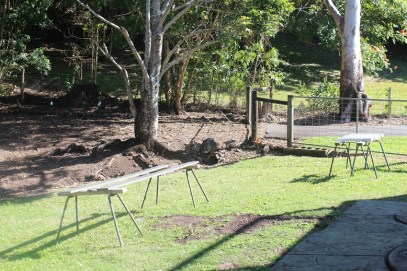
We normally do the painting under the house but on a sunny and windy day like today it was perfect to paint outdoors.  The shorter pieces on the trestles at the right of the photo are the corner posts for the cold frame.

There will be more photos when the construction is completed.